
Active Recall: What It Is and How to Do It (With Examples)
Active recall is a study method where you test yourself by pulling information out of your memory instead of rereading or highlighting your notes. It is also called retrieval practice, and it is one of the best-supported study techniques in learning research. You close the book, try to answer a question from memory, then check what you missed. That effort to remember is what helps the material stay with you for an exam days or weeks later.
| Term | Definition | Best for | Strength of evidence |
|---|---|---|---|
| Active recall (retrieval practice) | Bringing information to mind from memory, for example by answering a question without looking at your notes | Long-term retention and finding gaps in what you know | High: practice testing was rated high utility in a 2013 review of 10 learning techniques |
| Spaced repetition (distributed practice) | Reviewing the same material at increasing intervals over time | Retaining many items, such as vocabulary, over the long term | High: distributed practice was also rated high utility in the same review |
| Rereading and highlighting | Going back over notes or a text, or marking passages | Feeling familiar with the material, though rereading can give a false sense of confidence | Low: both were rated low utility in the same review |
What is active recall?
Active recall is the act of pulling out information from your memory. That might sound a little confusing, so here’s an example. Let’s say that you’re studying for a biology test, and you need to define osmosis. Instead of restudying the definition in your notes (“Osmosis is the movement of water across a selectively permeable membrane,”), active recall would involve asking yourself a question (“What is osmosis?”), and then attempting to remember the answer, before opening up your notes to see whether you got it correct. If you did, awesome! If not, now you know to review that particular term.
Birmingham City University describes active recall as a learning method where you continuously test yourself by pulling information out of your memory instead of just passively reading notes. One way to do this is blurting, where you write down everything you can remember about a particular subject and then check what you missed. Blurting can be a little messy but it is effective!
You might have also heard of retrieval practice, practice testing, the testing effect, or test-enhanced learning. These all refer to the way in which actively recalling (aka retrieving) information from your memory leads to stronger long-term learning and memory.
How active recall works

Have you ever tried to recall the answer to something and come up short? Believe it or not, that counts as a benefit of practicing active recall! Active recall or retrieval practice focuses on getting information out, the complete opposite of most types of studying which involve getting information in through means of reading, reviewing and taking notes.
According to retrievalpractice.org, more than 100 years of cognitive science research indicates that much of learning involves getting information out. Three benefits of actively retrieving answers include:
- Strengthening memories – When we make the effort to recall something, we strengthen memory links which makes recalling that same information easier the next time. For example, research shows that students who practiced recalling the information in a passage remembered significantly more information days later compared to students who restudied the passage.
- Better long-term memory – Studies indicate that the effort involved in recalling information strengthens long-term memory.
- Identify what you don’t know – Not being able to answer a question can help identify specific topics which need more work.
Struggle is a critical part of the learning process. Researchers refer to this type as desirable difficulty which is beneficial for our brains. Even unsuccessful attempts of recall enhance long-term memory, according to the University of Arizona's Thrive Center.
The research behind active recall and retrieval practice
The first documented studies on this testing effect were published back in 1909 by Edwina E. Abbott. More recent studies have continued to support its efficacy:
| Study | What students did | What it found |
|---|---|---|
| Roediger and Karpicke (2006), Psychological Science | Studied prose passages, then took free-recall tests or restudied the material | Restudying did better on a test 5 minutes later, but prior testing produced substantially greater retention on tests 2 days and 1 week later |
| Karpicke and Blunt (2011), Science | Practiced retrieval or studied with concept mapping | Retrieval practice produced greater gains in meaningful learning, including on questions that required inferences |
| Dunlosky and colleagues (2013), Psychological Science in the Public Interest | Review of 10 common learning techniques | Practice testing and distributed practice were rated high utility; rereading and highlighting were rated low utility |
A 2006 study by Roediger and Karpicke found that although restudying was more effective in improving test performance after 5 minutes, students who were tested on the material via recall questions showed much better test performance after 2 days and 1 week. The study also found that repeated rereading of information can mislead students into thinking that they know the information well, but this information does not stick around as well as information practiced through recall.
In a 2011 study published in Science, Karpicke and Blunt found that retrieval practice is even more powerful than elaborative studying with concept mapping for developing deeper learning and comprehension (e.g. they found that students who engaged in retrieval practice were better at answering inference-based questions, and at drawing a more effective concept map at the end, than students who created a concept map during their studying).
In a review of the efficacy of 10 commonly used learning techniques, John Dunlosky and colleagues gave practice testing (along with distributed practice) the highest utility rating for learning. Rereading and highlighting, on the other hand, were given the lowest utility ratings for learning. This article was published in 2013 by the Association for Psychological Science.
In short, when you engage in active recall, you’re strengthening your memory traces and improving your odds of remembering the material in the long-run (much better odds than you’d have from just restudying it!). Some researchers call this effort of remembering desirable difficulties. Plus, active recall allows you to see exactly which areas you still don’t quite have down.
How to do active recall: 5 methods

1. Flashcards
Flashcards are one of the most classic ways to actively recall information. You write a term or question on one side of the flashcard and the answer on the other. Hold up the flashcard, try and answer before looking, and sort it into either a correct or incorrect pile. Once you’ve gone through them all, shuffle the incorrect pile and test again in an hour or the next day.
If paper and flashcards aren’t your thing, there are tons of flashcard apps you can use (Anki, RemNote, Quizlet, etc). Because the flashcard apps show you the question before the answer, you’re practicing active recall when you try to answer before revealing it. Since Anki and RemNote also space out reviews, they also incorporate the benefits of spaced repetition!
Flashcards are great, but it takes a LONG time to make them! With StudySim, the study app built by the author’s company, you can turn a PDF of notes into flashcards. We’ll make a set of flashcards to save you time so you can spend more time actively recalling information.
Full decks of flashcards are part of StudySim Pro, but you can try out a few sample cards first.
2. Blurting
Also called a brain dump, blurting is when you:
- read a section of your textbook or look through your notes
- then, close the book/notes and grab a blank piece of paper
- write down everything you remember from what you just read/saw
- once you run out, check through your notes/book and circle the things you got wrong/missed.
Birmingham City University describes the technique as messy, but effective.
3. Practice questions and past papers
One of the most effective ways to prepare for a test is by taking a practice test! Try answering some questions at the end of the chapter, a previous quiz in the course, or even past papers from the course (ask your prof if they have them!). Don’t peek at your notes.
Don’t have a past test you can practice with? Make your own! Grab a piece of paper, and make a list of 5-10 questions based off of your notes/textbook. Number them, then grab another piece of paper for an answer key.
With StudySim, you can upload PDFs/notes and get a practice quiz from them, or compare the best AI quiz generators for students first.
4. Teach it (the Feynman technique)
Known as the Feynman technique, explain the material in simple terms to someone else (a friend, a family member, your pet, etc). Struggling to explain or having to frequently reference your notes probably means you need more of a grip on the concepts.
No one to explain it to? Explain it to your shoe; this technique is apparently called rubber ducking and is used by software developers.
5. Turn your notes into questions
If you already take really good notes (congrats), active recall might be as simple as flipping your notes into questions. Then, when you look through your notes, you can test yourself rather than just rereading them. Our guide to science-backed study methods shows how active recall fits with spacing and other techniques.
Active recall vs spaced repetition

Active recall refers to how you study: you pull knowledge out of your head (recall) instead of putting new information in (like rereading your notes). Spaced repetition is about when you study: reviewing material with increasingly long time gaps in-between so that you learn it just before you’d otherwise start forgetting it.
| Active recall | Spaced repetition | |
|---|---|---|
| What it is | Retrieving information from memory, for example by answering a question without notes | Reviewing material at increasing time intervals |
| Origin | The first documented testing-effect studies were published in 1909 by Edwina E. Abbott | First conceived in the 1880s by Hermann Ebbinghaus, who created the forgetting curve |
| Evidence | Practice testing rated high utility (Dunlosky and colleagues, 2013) | Distributed practice rated high utility (Dunlosky and colleagues, 2013) |
| Common methods | Flashcards, blurting, practice questions, teaching the topic | Flashcard software that schedules reviews, or the Leitner box system for paper cards |
| Example schedule | Answer, check and fix in every session | The day after the lesson, three days later, then a week after that |
They’re incredibly powerful study techniques when used together: by actively recalling information and spacing out your study sessions, you’ll make sure you learn it just in time before you start to forget it.
Using a flashcard app that schedules reviews for you utilizes both spaced repetition and active recall. Actively recalling the answer when shown the prompt on the flashcard is a retrieval effort. The flashcard app also determines when it’s best to view them again!
Active recall example: a 20-minute biology session

Imagine that you have biology class tomorrow and are learning about diffusion, osmosis, and active transport. Here’s what 20 minutes of studying those concepts might look like using active recall:
- (5 min) Read your notes/textbook on the topic of cell transport
- (5 min) Grab a piece of blank paper and try to write down what you can remember. You might write stuff like “Osmosis is the movement of water across a selectively permeable membrane,” diffusion is when molecules go high to low concentrations, and that active transport takes energy
- (5 min) Compare your notes to what you wrote down, circling stuff you got incorrect/missed out. Maybe you realized that diffusion & osmosis are both passive (i.e. DON’T require energy from the cell).
- (5 min) Make a few flashcards on things you struggled to remember (Osmosis: _______ + selectively permeable membrane, name all 3 types of transport, Which is/aren’t active?, etc.)
Next day, review the new questions you made (mark whether you answered correctly or not), then again in 3 days, then a week.
Active recall worksheet
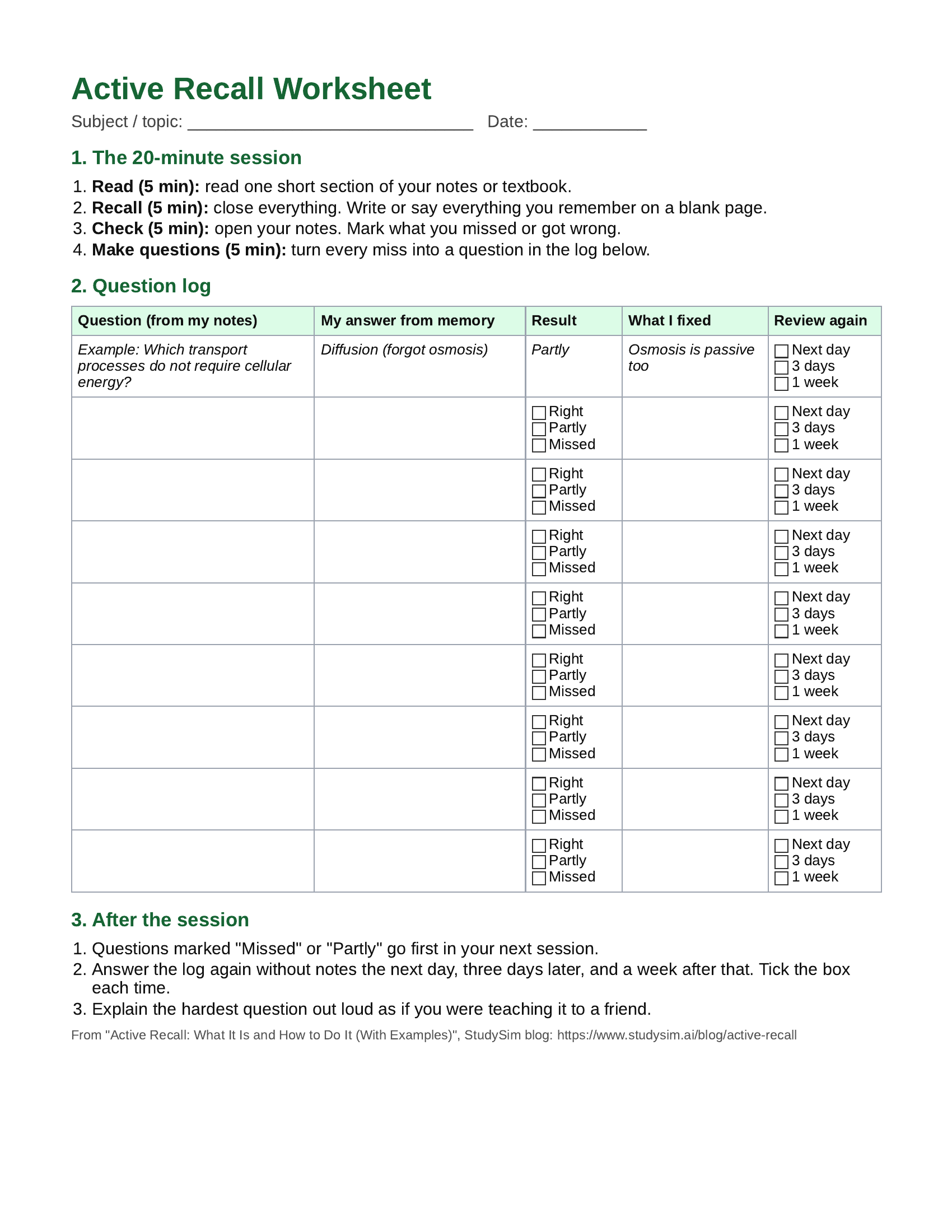
This printable worksheet has an outline of the 4 steps we walked through above to do an active recall study session, space to write the material you're struggling to recall + whether you got it right, and boxes to check when you've reviewed the material the next day, three days later and a week later.
Watch: how to do active recall
This video from the YouTube channel simple, actually explains why rereading feels productive but works poorly, walks through six steps for active recall, and ends with the 20-minute session used in the example above:
FAQ
What is another word for active recall?
Retrieval practice is the most common alternative name. You will also see practice testing, the testing effect and test-enhanced learning used for the same idea.
What are some examples of active recall?
Flashcards, blurting (writing everything you remember on a blank page), answering practice questions or past papers, teaching the topic to someone else, and rewriting your notes as questions.
Is active recall better than rereading?
For long-term memory, yes. In Roediger and Karpicke's 2006 study, restudying did better on a test five minutes later, but students who had been tested remembered substantially more two days and one week later. A 2013 review also rated rereading as low utility.
How often should you do active recall?
Spread your sessions out instead of cramming. Birmingham City University suggests reviewing the day after your lesson, three days later, then a week after that, testing yourself at each review.
What are the best apps for active recall?
Flashcard apps such as Anki, RemNote and Quizlet are common choices, and the University of Arizona's Thrive Center lists all three. You can also do active recall with no app at all, using paper flashcards, blurting and past papers.
Does active recall help with understanding, or only memorizing?
Both. Karpicke and Blunt (2011) found that retrieval practice produced more meaningful learning than studying with concept mapping, including on test questions that required students to make inferences.
About the author
Jozef Gherman is the founder of xyzai.io, the company behind StealthGPT and StudySim, where he builds AI tools that help students and writers study smarter and write with confidence. He writes about study techniques, exam prep, and practical ways to use AI for learning.