How to Study for Exams: A 7-Day Plan That Works
To study for exams, start seven days out: find out what the exam covers and how it is scored, split the material into four or five chunks, turn each chunk into questions and flashcards, then test yourself on a spaced schedule instead of rereading your notes. Take one full timed practice test two days before, fix what you missed, and sleep the night before. This guide covers how to study for a test you have a week to prepare for, and it comes with a free printable 7-day exam study plan.
| Step | Action | When |
|---|---|---|
| 1. Scope the exam | Find out the format, topics and grade weight | Day 7 |
| 2. Chunk the material | Split the topics into 4 or 5 chunks by chapter, topic or lecture | Day 7 |
| 3. Prepare study material | Make a study guide, flashcards and a list of likely questions | Days 6 to 3 |
| 4. Test yourself | Answer questions from memory, then check | Days 5 to 1 |
| 5. Space your review | Come back to every earlier chunk for a shorter review | Days 5 to 3 |
| 6. Take a full practice test | Time it and work without notes | Day 2 |
| 7. Fix mistakes and sleep | Redo what you missed, then go to bed on time | Day 1 |
Try the Quiz generator
How to study for exams: what you need

Start by collecting all of your materials: notes, readings, practice quizzes or homework problems, the syllabus or assignment, any study guide your teacher gave you, practice tests or tests from previous years if your teacher will give them to you.
You also need a calendar, a stack of index cards or a flashcard app, a timer, and a place where you can study without your phone.
Step 1: Find out what the exam covers and how it is scored
Start by figuring out what you need to study for. The Princeton Review recommends finding out whether the test has multiple-choice questions, short answers or an in-class essay, because the goals and layout of the test decide how you should learn the material. Figure out what chapters or units it will cover, how long it will be, and how much it’s worth.
Example: The midterm will be 75 minutes in length and consist of 40 multiple-choice questions and two short-answer questions. The material covered will be from chapters 4-9. The exam will be worth 20% of your course grade. For short answer questions, you’ll want to focus on learning the information so you can explain it well.
Common mistake: studying everything the same way. If the exam is mostly problems, reading the chapter again will not prepare you to solve them.
Step 2: Break the material into chunks
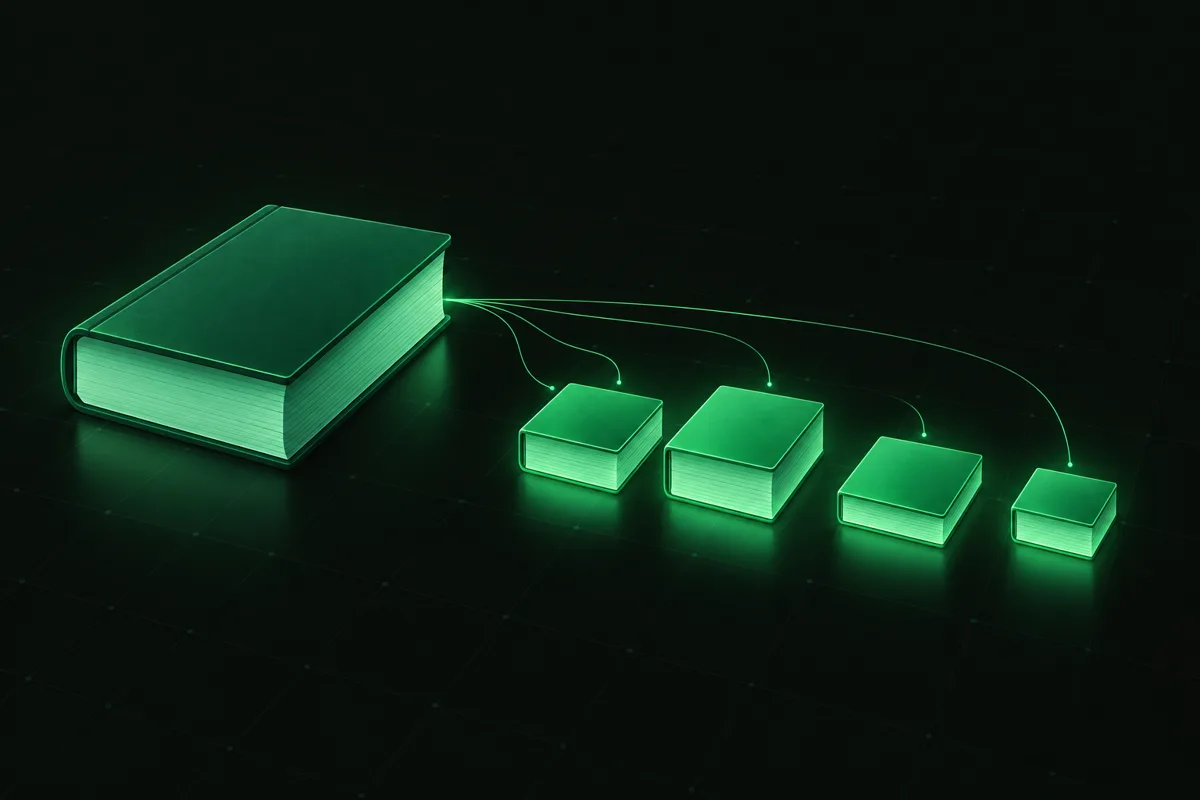
Divide up the information you need to study into chunks, by chapter, by lecture, by subject, etc. and put one chunk on each day of your study plan.
Start with the most difficult material so you’ll have more days to go back over it. Use four or five chunks, give each one its own preparation day, and keep the last two days for a full practice test and for fixing mistakes.
Example: There are four chunks for the biology midterm: Chunk A (Ch. 4 and 5), Chunk B (Ch. 6), Chunk C (Ch. 7 and 8), and Chunk D (Ch. 9).
Common mistake: making chunks too large. A chunk should be something you can prepare in one study session.
Step 3: Prepare study material, not more rereading
Cornell University’s Learning Strategies Center recommends active studying over rereading chapters or rewriting notes. Instead, condense your information into a format that’s useful to you, concept maps, flashcards, practice tests, outlines, etc. Make a list of 20 topics that could be on the exam and explain why each one might show up on the test.
For each chunk, write a one-page summary in your own words, make flashcards for the terms and formulas, and write five to ten questions in the same format as the exam. Our guide on how to make a study guide shows a basic structure you can copy for each chunk.
Common mistake: equating highlighting with studying. A large review of learning techniques by Dunlosky and colleagues rated highlighting and rereading as low-utility techniques.
Step 4: Test yourself with practice questions
Testing yourself is the core of how to study for exams. Of the 10 study techniques that researchers Dunlosky et al. reviewed, practice tests were one of only two they considered to have a high level of utility! In one study, researchers Roediger and Karpicke found that having students take tests on prose passages resulted in much better recall both two days later and one week later when compared to having students reread the material. Rereading also made students more confident that they would remember the material, even though they remembered less later on. Check out our guide to active recall for tips on how to test yourself effectively (and honestly!).
Practice tests help you figure out what information you need to go back over, give you practice answering questions, and help cement the information you’re learning in your brain. Answer each question from memory first, then check your notes and mark anything you missed or guessed.
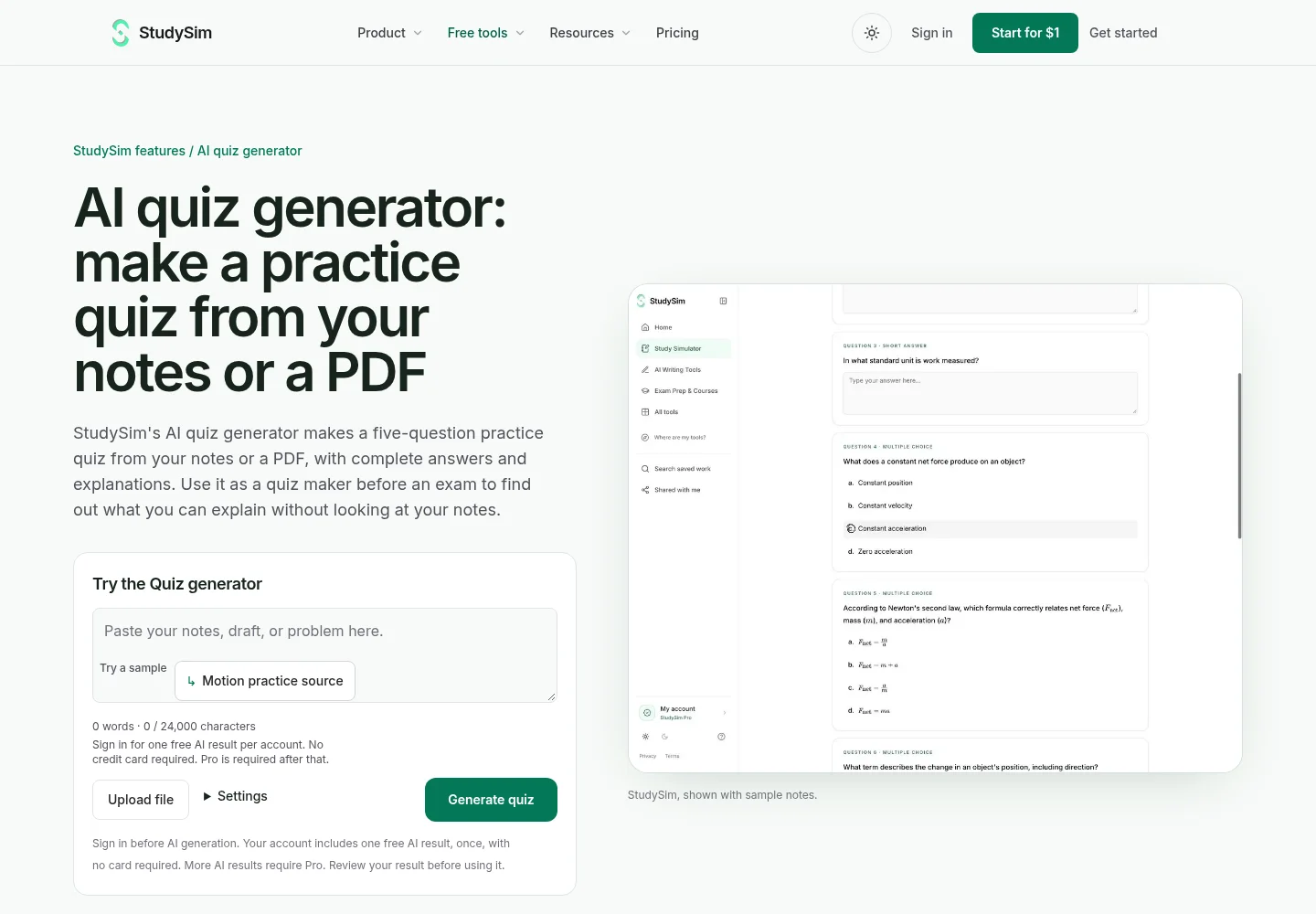
Writing questions for every chunk takes time. StudySim’s AI quiz generator lets you generate practice quizzes (with answers and explanations!) from your notes, just paste or upload them as a PDF and StudySim will whip up a five question quiz for you to test yourself. Struggling with certain terms? You can also turn a PDF into flashcards and drill just those. The free practice test library also has original questions with explanations for AP, SAT, ACT and nursing exams.
Common mistake: looking at the answer before you try to answer the question yourself. That way you only practice recognizing the answer, not producing it.
Step 5: Space your review across the week
Spacing out your studying instead of doing it all at once helps you retain information longer.
Start planning a week ahead of time and dedicate one day of that week to each chunk of information you’ll be tested on. Each day, go back over what you’ve already learned and add in the new information for that day. As explained in our spaced repetition guide, leaving a topic and coming back to it later has advantages.
Common mistake: studying in one long block of time. The UNC Learning Center suggests intensive sessions of 30 or 45 minutes with breaks instead of drawn-out studying.
Step 6: Take a full practice test under exam conditions
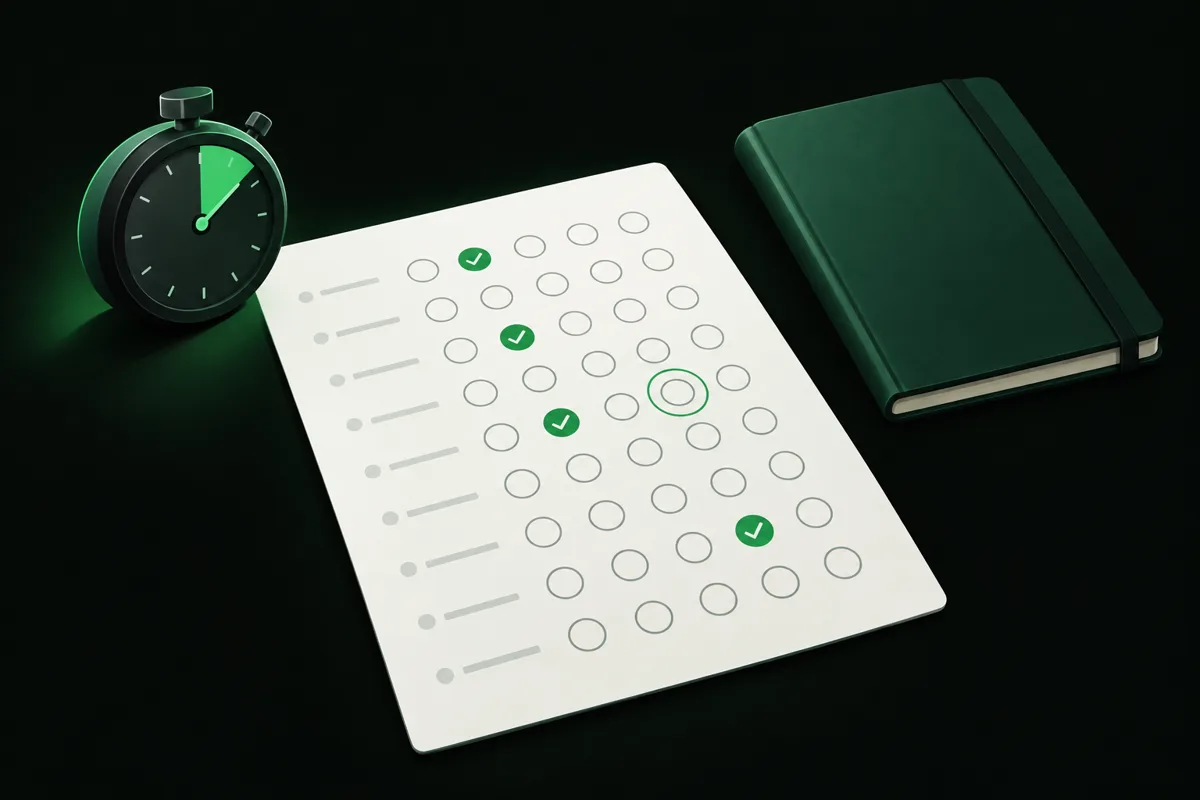
Try to mimic the conditions of your actual test as best you can: Colorado State University's Institute for Learning and Teaching suggests finding a quiet, distraction-free place, setting a timer for the time allowed on the real exam, and answering without your notes or textbook. If possible, do it in the same building or even seat you’ll be taking the test in! Do this two days before your exam, without any notes or materials.
Use a practice exam from your instructor if one exists. If not, compile all of the questions you’ve come up with throughout the week, mix them up, and see how you do.
Common mistake: stopping to check your notes mid-test. Pausing to check notes hides exactly the gaps the practice test is supposed to show you.
Step 7: Review your mistakes and protect your sleep
Get a feel for what types of questions show up again and again and what you continually get wrong so you can focus on that material. Try to figure out why you got them wrong. Did you misread the question? Misunderstand the material? Forgive yourself, reread the material, and try again.
Go over your notes one last time and go to bed at a reasonable hour. The CDC recommends 8 to 10 hours of sleep a night for teens aged 13 to 17 and 7 or more hours for adults aged 18 to 60. On the morning of the exam, The Princeton Review suggests a quick review, such as shuffling through your flashcards a couple of times, so the material is fresh.
Common mistake: staying up all night to go over everything once again. If you followed the plan, by the end of the week you’ve gone over everything several times.
Sample timeline: how to study for exams in 7 days

This one week study plan was inspired by Cornell University’s five-day plan. We adapted it for one week and four chunks of material. Tweak it as needed to fit the amount of chunks of material you’re studying and the amount of days you have until your test. Each day should take about two hours to complete, including breaks.
| Day | Task |
|---|---|
| Day 7 | Scope the exam, gather materials, split them into chunks A to D, list 20 likely topics |
| Day 6 | Prepare chunk A: summary, flashcards, practice questions |
| Day 5 | Review chunk A, then prepare chunk B |
| Day 4 | Review chunks A and B, then prepare chunk C |
| Day 3 | Review chunks A, B and C, then prepare chunk D |
| Day 2 | Take a full timed practice test on chunks A to D |
| Day 1 | Redo missed questions, go through flashcards, sleep on time |
| Exam day | Shuffle through your flashcards once or twice, then go to the exam |
If you have several exams at once, use our two-week plan for finals instead, and see our guide to building a study schedule for the rest of the term.
Common mistakes when you study for a test
Most study plans fail for the same few reasons. Here are the ones these sources warn about most and what to do instead.
| Mistake | Fix |
|---|---|
| Rereading notes and highlighting | Make questions and flashcards, then answer them from memory |
| Cramming the night before | Spread short sessions over the week and review earlier chunks |
| Studying in long blocks without breaks | Use focused 30 to 45 minute sessions with breaks |
| Studying with your phone nearby | Turn off notifications or turn your phone off |
| Ignoring the exam format | Practice the same question types the exam uses |
| Skipping the practice test | Take a full timed practice test two days before |
| Not checking why you got questions wrong | Sort each miss by cause and redo it from memory |
Free printable 7-day exam study plan
We turned the steps above into a two-page plan you can print. It includes an exam scope sheet, a study chunk planner, a 7-day calendar (with prep and review slots), a practice test log (to sort through your mistakes) and a night-before checklist. Download the 7-day exam study plan (PDF) and fill it in on day 7.
When you need practice questions for a study session, paste that chunk's notes into the quiz generator, log the questions you miss in the plan, and come back to them on the next review day.
FAQ
What is the best study method for exams?
Practice testing and spaced review. A 2013 review of ten learning techniques by Dunlosky and colleagues gave practice testing and distributed practice the highest utility ratings, while highlighting and rereading were rated low. In short: answer questions from memory and spread your sessions out over several days.
How long should I study for an exam?
For a typical class exam, plan on about a week. Cornell's Learning Strategies Center uses a five-day plan with about two hours of studying each day, and notes that an hour a day for 20 days beats 10 hours a day for two days. Start earlier for cumulative or high-stakes exams.
What is the quickest way to study for an exam?
If you are short on time, skip rereading and go straight to self-testing: answer practice questions or flashcards on the topics most likely to be tested, check your answers, and redo the ones you miss. Still get a full night of sleep before the exam.
How can I focus when studying for a test?
Remove distractions and keep sessions short. The UNC Learning Center recommends turning off your phone, limiting time on distracting sites, and studying in intensive 30 or 45 minute sessions with breaks. It also notes that multitasking hurts results.
Can AI help me study for a test?
Yes, if you use it to test yourself rather than to read summaries. StudySim's AI quiz generator turns your own notes or a PDF into a five-question practice quiz with answers and explanations. Signing in gives you one free AI result, and more results require StudySim Pro. Always check the explanations against your course material.
About the author
Jozef Gherman is the founder of XYZAI, the company behind StudySim, where he builds AI tools that help students and writers study smarter and write with confidence. He writes about study techniques, exam prep, and practical ways to use AI for learning.