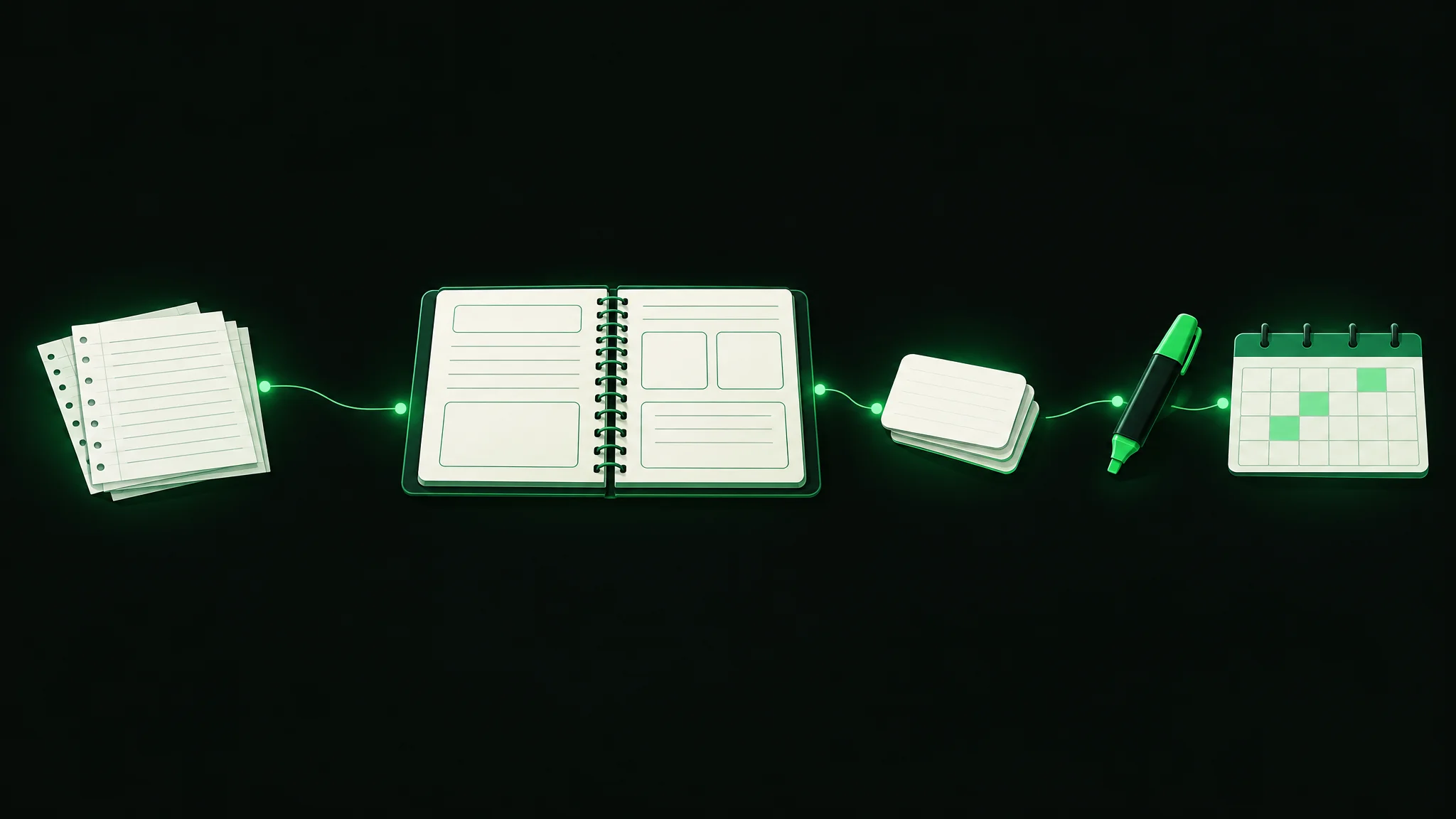
How to Study for Finals: A 2-Week Game Plan + Free Planner
To study for finals, start two weeks before your first exam: put every final on one calendar, rank them by grade weight, difficulty and date, and sort each course's topics into what will definitely, probably and might be tested. Then study with practice tests instead of rereading, rotate subjects across short blocks, and protect your sleep. This is a guide to finals week when you have several exams at once. Print out or grab a copy of the free 2-week finals planner and start planning out what you’ll do during each study session.
| Step | Action | When |
|---|---|---|
| 1. Map every final | Put all exams, papers and projects on one calendar | Day 14 |
| 2. Rank your finals | Order them by grade weight, difficulty and date | Day 14 |
| 3. Sort the topics | Split each course into definitely, probably and might be on the final | Day 13 |
| 4. Build the schedule | Break each course into small tasks and assign them to days | Day 13 |
| 5. Test yourself | Use practice tests and flashcards instead of rereading | Days 12 to 2 |
| 6. Space and mix subjects | Rotate courses and come back to each one several times | Days 12 to 2 |
| 7. Protect sleep and breaks | Skip all-nighters, take breaks, eat real meals | Every day |
Try the Quiz generator
What you need to study for finals

Finals are different from other tests because, as The Princeton Review explains, finals are testing everything you’ve learned in the class during the semester, and you’re likely taking a bunch of finals during finals week. That means the challenge of finals isn’t so much any individual exam as it is dividing up your time between all of your classes’ exams.
Before you plan anything, collect these for every course: the syllabus with the grading breakdown, the final exam date, time and room, any review sheet or list of learning objectives, your lecture notes and slides, and your old quizzes and midterms with feedback. Ask your instructors whether they share past finals, since they show what might be covered and how questions are phrased. You will also need a calendar, a stack of index cards or a flashcard app, and a quiet place to study with your phone on Do Not Disturb.
Step 1: Put every final on one calendar
Write down all the days, dates, and times of your finals (as well as any projects or papers you have due around the same time) in a calendar. This could be a paper planner or the calendar on your phone. As The Princeton Review suggests, plan study sessions for all of your finals at once. That way, you can get a sense of how much you have to do and won’t leave the later exams until a couple nights before. Set reminders for your study sessions so you’ll remember to stick to your schedule. Make your study sessions specific.
Example: say you have a paper due on the 12th and then 5 finals from the 14th to the 18th. Count back two weeks from your first final. That’s when you should start studying for finals.
Common mistake: planning only one final at a time. If you only look at the next exam, the later ones get squeezed into the last two nights.
Step 2: Rank your finals by weight, difficulty and date
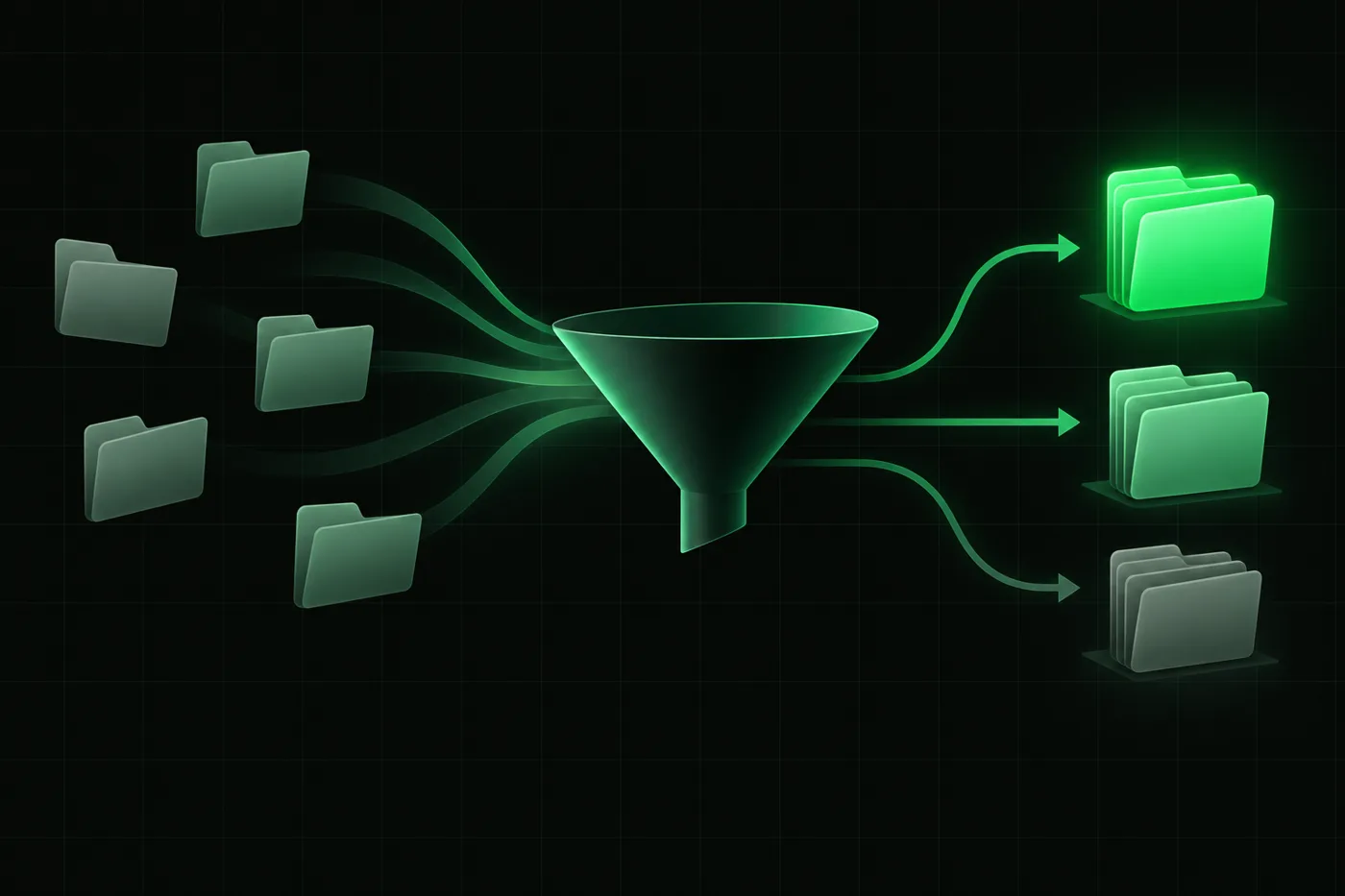
Check your syllabi to see how much of your grade your finals are worth and think about how well you think you’ll do on each exam. As Saint Louis University’s communication department suggests, make a list of all the work you still have left to do and assign each class a rating for how well you think you’re prepared.
Figure out which classes to spend the most time on. Focus on studying for the classes you’re least confident about – even if their exams are last in finals week. Take another look at the quizzes and exams you’ve already taken in each class, especially the ones you didn’t do as well on. As The Princeton Review explains, if you did poorly on an exam, it could mean you didn’t pick up on the material the first time.
Common mistake: spending most of your time on the class you enjoy. It feels productive, but it leaves the class you are worried about until the end.
Step 3: Sort each course's topics: definitely, probably, might
As The Princeton Review suggests, divide up the list into three sections: things you know will be on the exam, things you think will probably be on the exam, and things that may be on the exam.
If your exam is cumulative (covering the whole semester), try not to only make a list of things learned in the last couple units. Next to each topic, add a color: red if you cannot explain it yet, yellow if you partly know it, and green if you can answer questions on it from memory. Save your energy for studying the material you need more practice with (anything in red or yellow). Focus most of your energy on the red items in the classes you rated yourself as being the least prepared for.
Common mistake: treating all topics as equally likely. Use your professor’s review sheet or your course’s learning objectives to guide you.
Step 4: Build a 2-week finals study schedule
Instead of writing “study for chemistry exam” as a to-do, the communication department at Saint Louis University suggests breaking it down into more manageable chunks like “make list of terms,” “review chapters 9-10,” “make flashcards,” and “go through lab notes.” Break down the things you need to do into even smaller steps and put them in your planner.
Give the exams you’re most worried about more time on the calendar and leave a day or two for extra studying in case you run out of time (TopUniversities suggests having “buffer” days in case anything unexpected comes up). And remember to schedule breaks!
Prefer watching over reading? Check out this short video on how to study for finals from The Angry Explainer. It covers how to prioritize what to study, use active recall, and divide up your study time.
Common mistake: a schedule that leaves no room for error. One sick day or a long paper wipes out the plan if every hour is already booked.
Step 5: Study for finals with practice tests, not rereading
According to the Association for Psychological Science, some commonly used study strategies are more effective than others. Of 10 popular learning techniques, the report rates practice testing and distributed practice as relatively high utility, and rereading and highlighting as relatively low utility. In a classic experiment, Roediger and Karpicke (2006) had students either be tested on a passage or restudy the passage. Although restudying made students more confident, students who were tested remembered more on a delayed test.
Close your notes and try to answer questions on each block you’ve just read (this is the heart of active recall). Work through old exams and problem sets with a timer, explain concepts out loud as if teaching a classmate, and make flashcards for dates, formulas and vocabulary. A study group can help as long as you quiz each other instead of chatting.
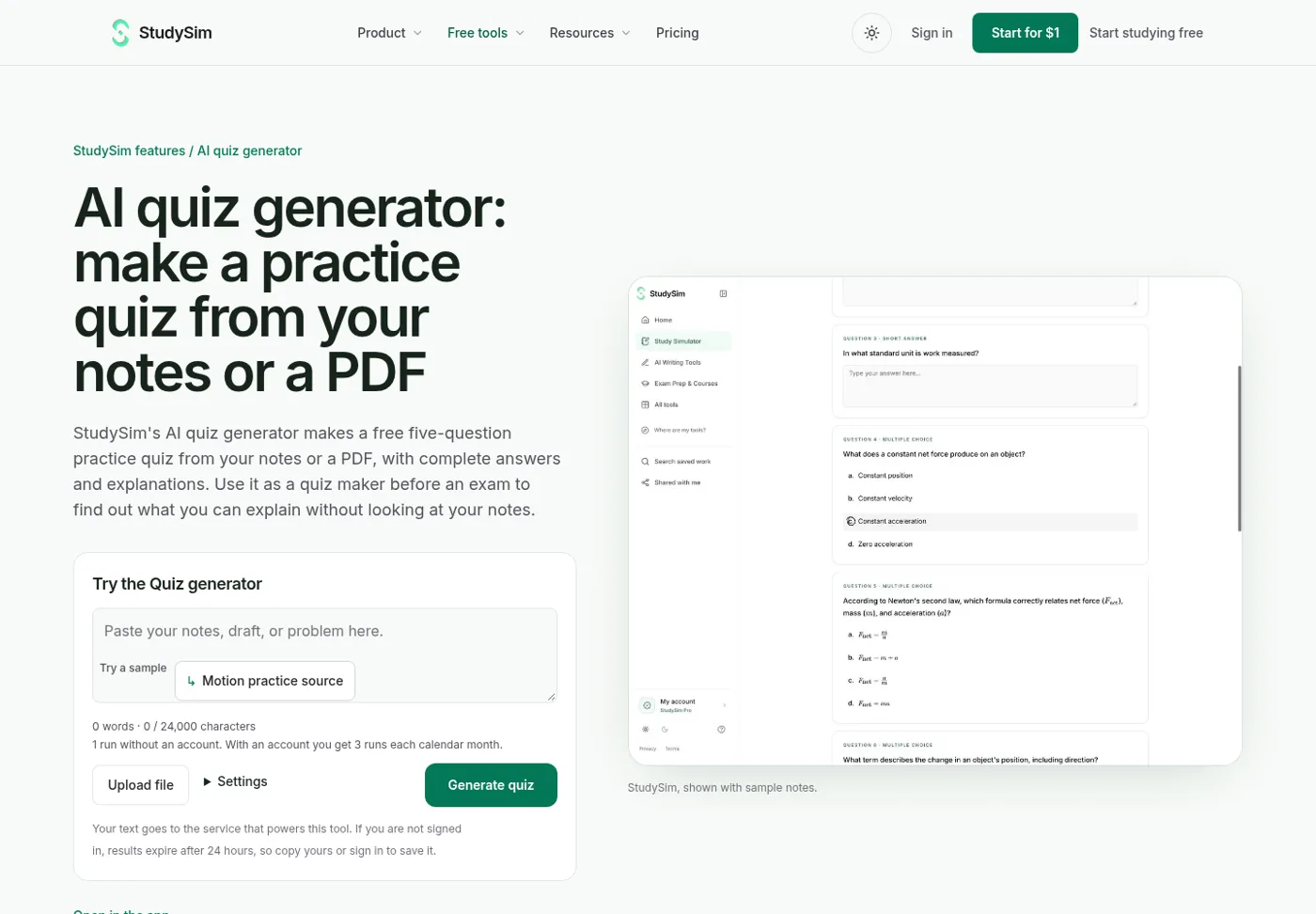
Writing questions for five courses takes time. You can use StudySim’s free AI quiz generator and paste in some of your notes to generate a 5 question practice quiz (with answers and explanations!) about the material you’re studying. You can also turn a PDF into flashcards for the words and phrases you keep getting wrong. For standardized exams such as AP, SAT and nursing tests, the free practice test library has original questions with explanations. Our guide to turning a PDF into a practice quiz shows you exactly how to do the quiz route.
Common mistake: rereading slides over and over until they look familiar. Recognizing material is not the same as being able to recall it on the exam.
Step 6: Space out and mix your subjects
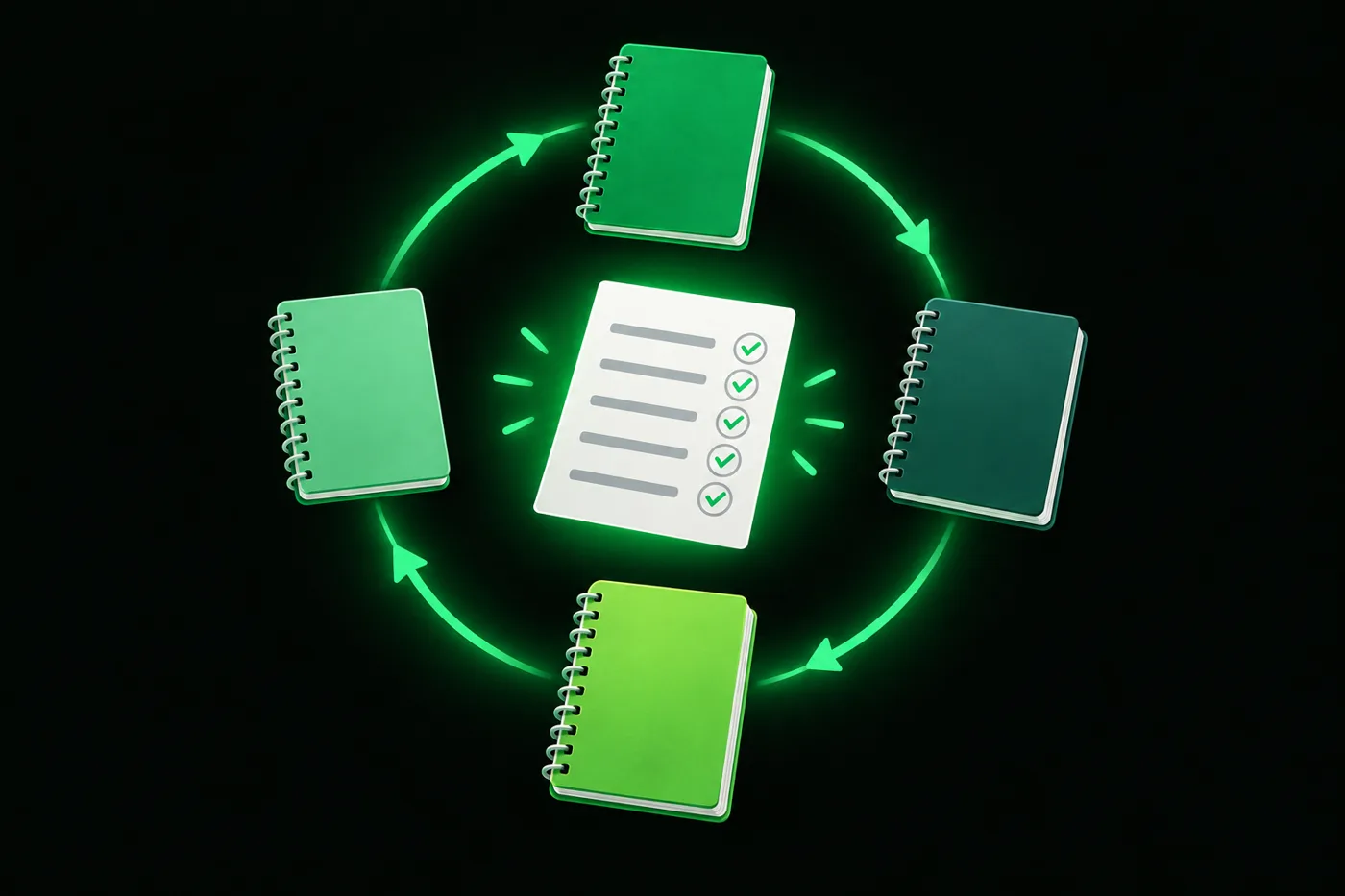
Start at least two weeks before finals so you’re not trying to learn everything the night before. This will give you more chances to go over the material instead of just once. Distributing your studying over time is one of the most well-researched learning strategies, and our guide to spaced repetition describes when to review material.
Alternate between subjects on the same day (this is called interleaving and The Learning Scientists explain it as jumping between concepts as you’re studying). This can help you learn how to tell which strategies to use for different types of problems and notice similarities/differences between ideas. Just make sure you’re not jumping around so much that you’re not getting anything accomplished.
Common mistake: blocking an entire day for each course. By the time you reach the last final, the first course has had no review for days.
Step 7: Protect sleep, breaks and meals
Get plenty of sleep! According to the CDC adults 18-60 should aim for at least 7 hours and teens 13-17 should aim for 8-10 hours. Staying up all night to study does more harm than good and The Princeton Review backs this up by saying it adds stress and you won’t retain the information for long.
Eat well, drink plenty of water, and try not to overdo it on the caffeine. Try the Pomodoro Technique: study for 25 minutes and take a 5 minute break. After 4 Pomodoros take a longer break (15-30 minutes). TopUniversities talks more about this technique.
Common mistake: cutting down on sleep to carve out more time to study isn’t going to help you retain the information, especially the last few days before the exam!
Sample timeline: how to study for finals in 2 weeks

Day 1 is the day before your first final.
| Day | Task |
|---|---|
| Day 14 | Map every final; gather syllabi, review sheets and old exams; rank finals |
| Day 13 | Sort each course's topics into definitely, probably and might; mark red, yellow and green |
| Days 12 to 11 | First practice test for your top-priority final; study its red topics |
| Days 10 to 9 | Rotate two courses per day with one practice block each; make flashcards for misses |
| Day 8 | Buffer day: catch up and review the first week's missed questions |
| Days 7 to 5 | Timed practice tests for one course a day; redo missed questions from memory |
| Day 4 | Mixed review: questions from all courses, shuffled |
| Day 3 | Office hours or a review session; last full practice test |
| Day 2 | Review only the questions you missed; light flashcards |
| Day 1 | Quick recall check, pack your materials, sleep |
Only have one exam to prepare for? Our guide on how to make a study guide includes a 7-day plan for a single test.
Common mistakes when you study for finals
Most finals plans break down in the same few ways. Use this table as a check before you start.
| Mistake | Fix |
|---|---|
| Planning one final at a time | Put every final on one calendar and plan all of them together |
| Giving every course the same time | Rank finals and give more time to your toughest classes |
| Starting at page one of your notes | Study what will definitely be on the final first, then probably, then might |
| Rereading and highlighting | Use practice tests, flashcards and explaining out loud |
| Cramming each course the night before | Spread sessions over the two weeks and rotate subjects |
| Pulling all-nighters | Keep a regular sleep schedule through finals week |
For more evidence-based methods, see our guide on how to study effectively.
Free printable 2-week finals study planner
Download this three-page study planner we made from the tips above. It includes a table for mapping and ranking your finals, a topic triage worksheet for each class, a 14-day calendar with two study sessions each day, a session tracker for what you tested and what you missed, and a night-before checklist. Download the 2-week finals planner (PDF), print one for each finals period, and start using it on Day 14.
Need study questions? Paste your lecture notes into this free quiz maker (you can generate one quiz without an account or sign up for a free account to generate three quizzes per month). Add the questions you missed to your study planner and circle back to them during the week.
FAQ
How long should you study for finals?
Start a few weeks before your first exam, and at least two weeks out if you have several finals. Plan how much time each subject needs per day, give the toughest classes more, and spread sessions out instead of cramming.
How do you study for multiple finals at once?
Put every final on one calendar, rank them by grade weight, difficulty and date, and split each course into small tasks. Then rotate two or three subjects per day so each course gets reviewed several times before its exam.
Is it better to pull an all-nighter before a final?
No. An all-nighter adds stress, and you will not retain the material for long. Stop early enough to sleep: the CDC recommends 7 or more hours for adults and 8 to 10 hours for teens 13 to 17.
What is the best way to study for a cumulative final?
List topics from the whole semester, check old quizzes and midterms for weak units, and study what will definitely be tested first. Test yourself with practice questions rather than rereading, and revisit early units more than once.
Can AI help me study for finals?
Yes. StudySim's AI quiz generator turns your notes or a PDF into a practice quiz with answers and explanations. It does not know your instructor's exam questions, so check it against your class materials.
About the author
Jozef Gherman is the founder of XYZAI, the company behind StudySim, where he builds AI tools that help students and writers study smarter and write with confidence. He writes about study techniques, exam prep, and practical ways to use AI for learning.