Note-Taking Methods: 7 Systems Compared
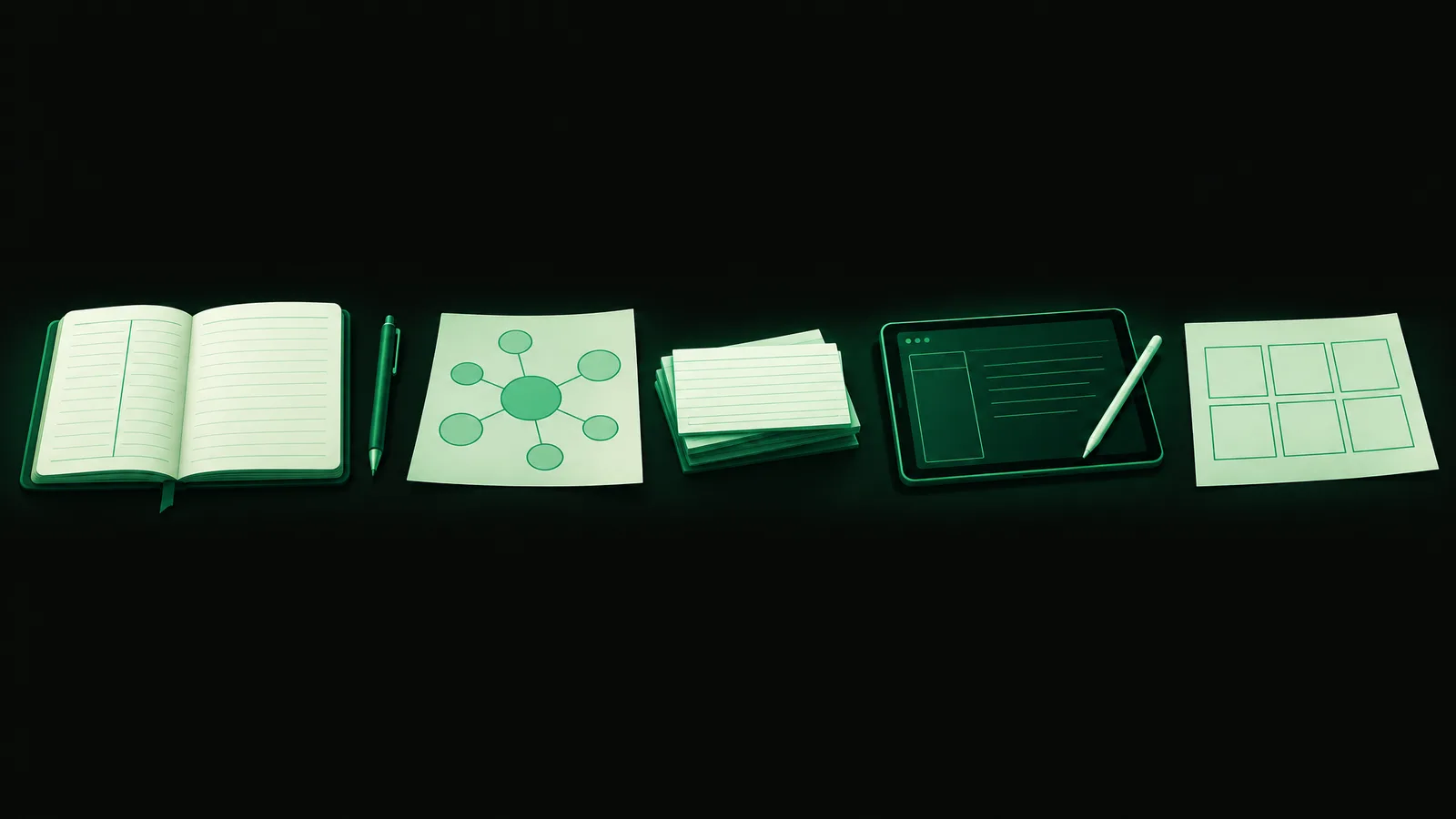
The best note taking methods for most students are the Cornell method, the outline method and the mapping method, with charting, sentence, boxing and flow-based notes for specific kinds of classes. Pick the method that matches how the class is taught, write in your own words instead of copying word for word, and turn your notes into questions you can quiz yourself on. Below are all 7 systems, how to do each one, a side-by-side comparison, a real Cornell notes example and a printable PDF with a blank template.
| Method | What it is | Best for | Evidence (from the source) |
|---|---|---|---|
| Cornell | A page split into a notes column, a cue column and a summary box | Lectures you will be tested on | Organized and systematic for recording and reviewing notes (UTC) |
| Outline | Main points on the left, details indented underneath | Lectures that follow a clear structure | Records content as well as relationships (UTC) |
| Mapping | A main topic with branches out to related ideas | Heavy, well-organized content or an unknown lecture format | Relationships can easily be seen (UTC) |
| Charting | Columns for categories, rows for items | Comparing items across the same features | Reduces the amount of writing necessary (UTC) |
| Sentence | Every new point on its own numbered line | Fast lectures heavy with content | Gets more or all of the information (UTC) |
| Boxing | Each subtopic in its own labeled box | Review and one-page summaries | Gives a summary of each lecture, chapter or subtopic at a glance (Goodnotes) |
| Flow-based | Points in your own words, connected with arrows | Understanding concepts, not just recording them | Rephrasing in your own words takes thought, which helps you retain more (Coursera) |
Try the Study notes generator
What the research says about note taking methods

Before you pick a format, it helps to know what makes notes work at all. One well-known study was conducted by Pam Mueller of Princeton University and Daniel Oppenheimer. It was published in Psychological Science and has been summarized by the Association for Psychological Science.
In one study, college students watched a TED Talk and took notes either by hand or on a laptop. After 30 minutes, students answered questions about the talk. Both sets of students did equally well on factual questions, but students who took notes by hand did better on conceptual questions. It turns out that students who took notes on a laptop wrote down more words, but many of the words were transcribed directly from the talk. Even when students were specifically instructed not to take verbatim notes, the results were similar, and a week later, those who’d used paper still outperformed their peers on a recall test when participants were given a chance to review their notes first.
It’s not just about taking notes – it’s about processing them and making them your own. That’s more valuable than a transcript.
While this doesn’t mean you shouldn’t take notes on a laptop, it does mean that it’s important to think about how you take notes, not just where you take them. After Dunlosky and colleagues reviewed research on different study techniques, they found that practice testing and distributed practice (studying information spread out over time) were highly effective ways to learn. On the other hand, techniques like re-reading and underlining weren’t as helpful. That is why the best note taking methods build in a way to quiz yourself with active recall and come back to the material over several days. For the bigger picture on study habits, see our guide on how to study effectively.
1. The Cornell method
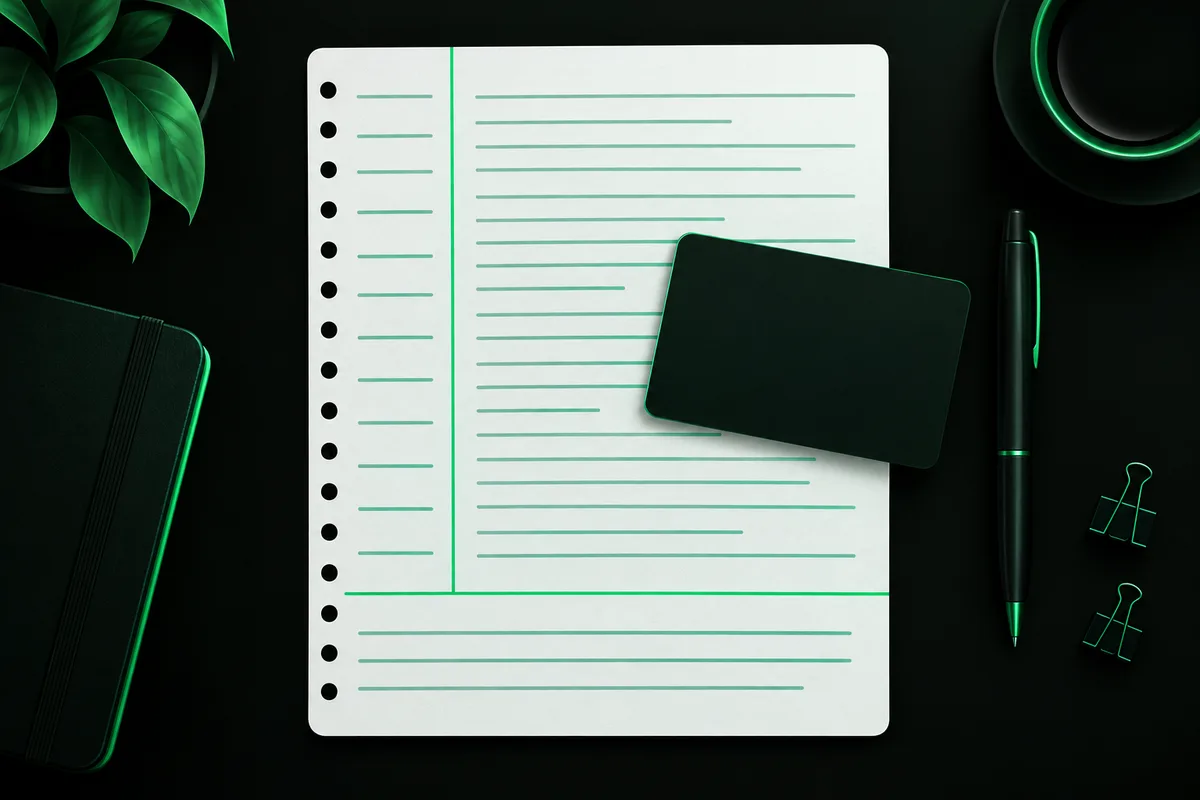
What it is
The Cornell note-taking system was developed by Cornell education professor Walter Pauk, who described it in his book How to Study in College. It splits each page into three parts: a wide column on the right for notes during class, a narrow column on the left for cues and questions, and a box across the bottom for a summary.
Fill in the cue column with questions that the notes on the right answer. Then, to review for a test, cover up the right side of the page, look at the question in the cue column, and try to answer it using your memory.
How to do it
- Draw a horizontal line two inches from the bottom of the page and then a vertical line, stopping at the horizontal line, about two inches from the left side of the page
- Take notes in the big area on the right of the page. Leave a few lines between notes if your teacher changes topics
- After class, finish half-written phrases and sentences.
- For every important idea, write a cue in the left column: a key word or a question.
- Use the summary section at the bottom of the page to condense the notes into one or two sentences in your own words
- Try covering up the notes and reviewing from the cues. Say the answers out loud before checking yourself for accuracy
Cornell is a good system to use when you know that you will be tested on material since the Cornell note taking system incorporates a review component. To go further, turn each cue into a flashcard; our guide on how to make flashcards from your notes has the full procedure.
Cornell notes example
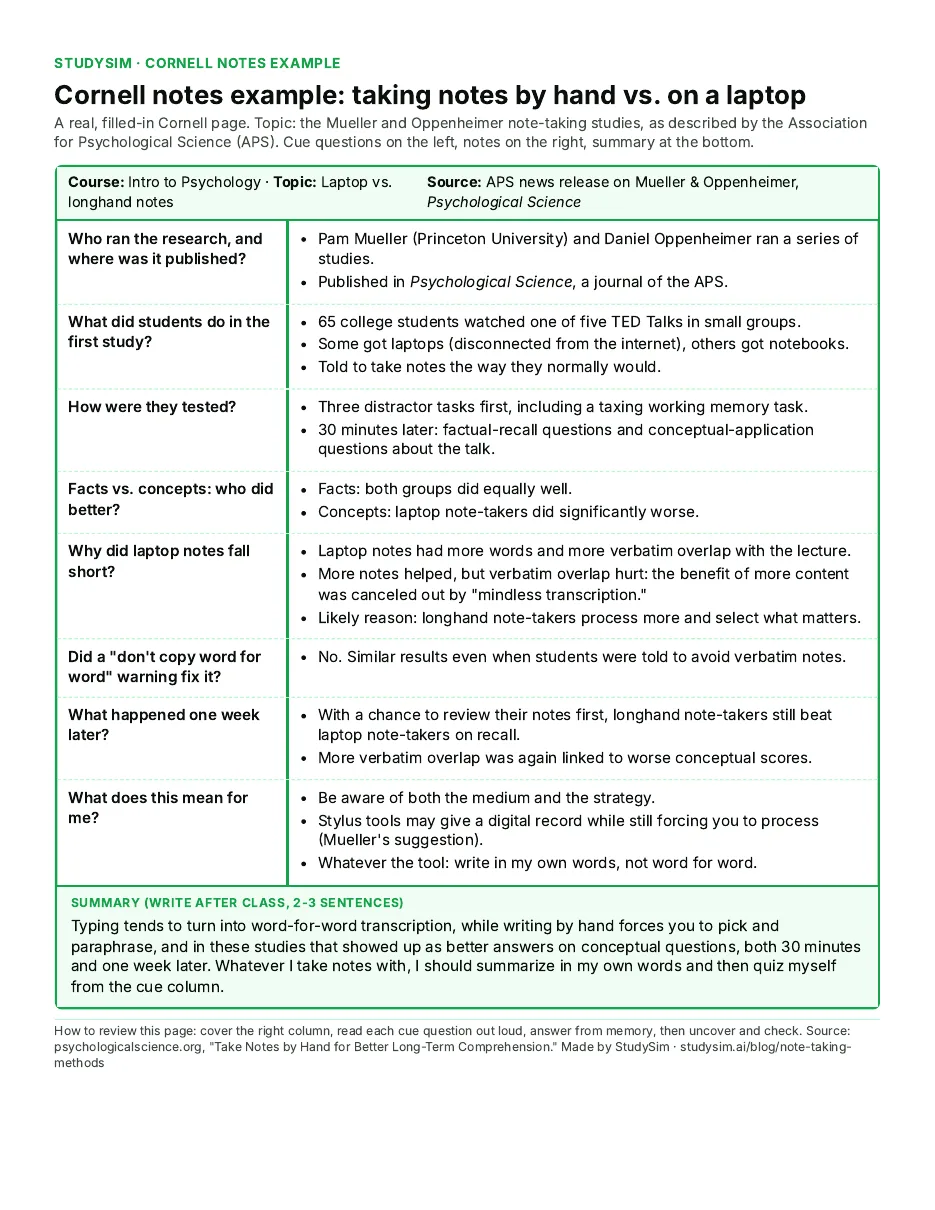
We filled out a sheet of Cornell notes about the study comparing taking notes on a laptop to writing notes by hand. We based the notes on information from the Association for Psychological Science. We kept our answers brief. And instead of putting “Results” in the cue column, we wrote specific questions like “Facts vs. concepts: who did better?”
A few things to copy from this example:
- Cues are questions, not labels. A cue like “Facts vs. concepts: who did better?” beats a one-word label. It’s easier to practice testing yourself using specific questions!
- Notes are phrases, not sentences. You should be able to jot down each bullet while the person is still talking.
- The summary answers “so what?” It spells out what the research means for your note-taking.
Download the Cornell notes example and blank template (PDF). Want to see Cornell notes in action? We put together a free PDF with an example Cornell note-taking page (the one pictured above), a blank Cornell note-taking page, and some tips for picking a note-taking system. Print it out and bring it to class!
2. The outline method
What it is
The outline method puts the most general information on the left, with each more specific point indented further to the right. How far a line sits from the margin shows how important it is, so the page records both the content and how the ideas relate.
How to do it
- Write the most important or general point at the far left of the page
- Indent supporting points to the right, and further details even farther to the right
- Keep each point to about one sentence
- Separate main points with Roman numerals, dashes, or just extra space
- Turn each of your main points into a question and cover up your notes. See if you can answer the questions without referring to your notes
The outline method is especially helpful if your professor gives you an agenda or syllabus for a lecture ahead of time. You can use that information to make headings and subheadings for your notes. If a lecture isn’t well-organized, or moves too quickly for you to decide what’s a main idea and what’s a supporting detail, you might want to try a different note-taking method. Diagrams can be tricky in outlines, so if you’re taking notes for a class where there are a lot of visuals, you might want to find another method. Outlines also translate well into a study guide later; see how to create a study guide for the next step.
3. The mapping method (and mind maps)
What it is
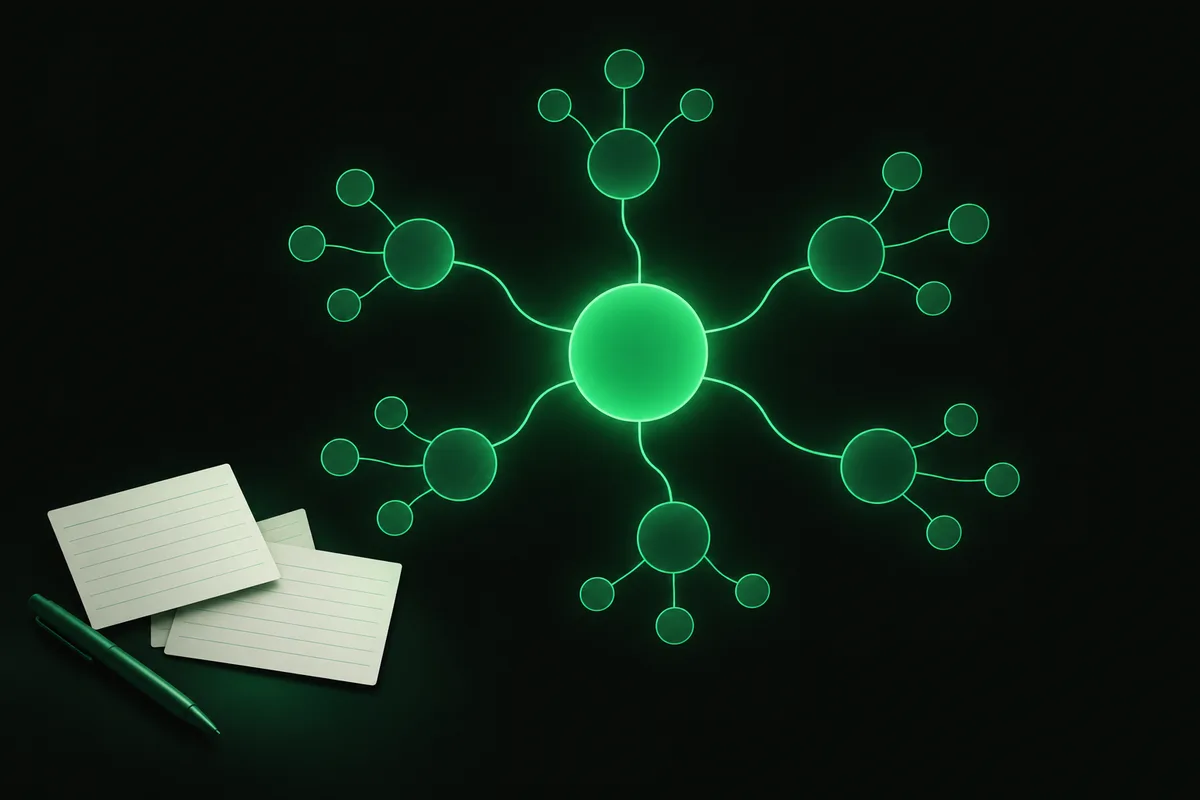
In mapping, you lay out a diagram starting with the main topic in the center, then adding branches for subtopics and further branches for details. This gives you a clear picture of how everything fits together. Mind mapping is similar, except it’s less rigid: again you begin in the center of the page and branch out from there, but it’s more suited to brainstorming than note-taking during a lecture.
How to do it
- Write down the central topic of the lecture at the top or center of the page
- Add each subtopic as a branch, connected with a line.
- Add details as smaller branches off of each subtopic
- After class, adjust the positions, add numbers or color coding, and redraw links you got wrong.
- Cover up different areas of your map and see if you can remember what goes there
You might run out of room on the page if your map has a lot of branches, or you might miss important transitions between big ideas and small details. Try mapping if you want to visually see how different ideas are connected to each other, especially if there’s a lot of information to keep track of in an organized lecture. Diagrams are an easy way to organize a lecture if you don’t know what to expect, like if a guest speaker is coming to talk to your class.
4. The charting method
What it is
With charting, information is recorded in chart or table format. Rows in the table would be the individual items you’re studying and columns would be different aspects or characteristics of those items. For example, let’s say you’re studying for a chemistry exam. Your rows could be the different elements and your columns could be characteristics of those elements like atomic mass, melting point, color, etc. Or, if you’re studying for a history exam, maybe your rows are different historical figures and your columns are characteristics of those figures like early life, major accomplishments, importance to history, etc.
How to do it
- Before class, figure out the categories your professor will likely talk about
- Draw and label each category as its own column
- Add notes as phrases and important ideas under each category
- To review, cover up one column at a time and try to remember what goes in each section
Charting doesn’t work for every lecture, especially ones that follow a particular story or order of events. But it’s helpful to cut down on how much you write and an easy way to study comparisons.
5. The sentence method
What it is
The sentence method, sometimes called the list method, puts every new thought, fact or topic on its own line, numbered as you go. It does not try to sort main points from minor ones during class. That leaves more of your attention for listening.
How to do it
- Create a new bullet or number for each new idea, fact, or topic mentioned
- Use as few words as possible – abbreviate and take notes in phrases, not full sentences
- Highlight or otherwise organize by main idea
- Rewrite your notes in your own words, preferably using one of the other note-taking methods listed above
This method is useful when the lecture is information-dense and moves quickly, but the list method is basically shorthand for transcribing what your professor says. Try sentence (or list) style notes when you’re able to pick out different pieces of information from the lecture, but aren’t quite sure how they all relate to each other yet.
6. The boxing method
What it is
This handy method (coined by a Goodnotes user) condenses an entire lecture, chapter or unit onto one page, with one labeled box per subtopic, making it easy to glance over all of your notes. It’s best done in an app that can help you draw straight boxes (no need for a ruler).
How to do it
- Use one page for one subject
- Draw a box for each different section of notes (for example, one box per lecture) and label the box
- Write down only the most important information in each box
- You now have one-page notes for the entire subject!
The boxing note-taking style isn’t so much a lecture note-taking method as it is a reviewing and condensing method. While it isn’t particularly helpful during a lecture (it’s pretty time consuming), condensing a week’s worth of Cornell or outline notes into boxes can be a helpful step before you build a study schedule for the exam.
7. The flow-based method
What it is
Flow-based notes are a concept developed by Scott Young. Flow-based note-taking focuses on the connections between information instead of writing everything down sentence-by-sentence.
How to do it
- Write down information from the lecture in your own words (not your professor’s words!)
- Use arrows to show connections between different pieces of information (does one fact contradict another? Does one fact build off of another?)
- Do not worry about a neat layout. The goal is to record the material as you process it.
- After class, write two or three questions the page should help you answer.
This is similar to what we saw in the research above: processing information is better than transcribing it. And flow-based notes force you to process information because you can’t just write things down line by line without rewording and relating concepts.
Note taking methods compared
Different note-taking styles work better for different types of classes. A good setup uses two or three: one style for taking notes during class, and another for condensing and reformatting notes after class.
| Method | Effort | Best for | When to use |
|---|---|---|---|
| Cornell | Simple and efficient once the page is set up (UTC) | Lectures you will be tested on | During class, then cues and summary after class |
| Outline | Requires more thought in class for accurate organization (UTC) | Lectures presented in outline form | When there is time in the lecture to make organizing decisions |
| Mapping | Little thinking is needed in class (UTC) | Heavy, well-organized content | Guest lectures or when you can't predict the format |
| Charting | Reduces the amount of writing (UTC) | Facts and comparisons | When the categories are known before class |
| Sentence | Quick to write, difficult to review until edited (Coursera, UTC) | Fast, content-heavy lectures | When you can hear the points but not how they fit together |
| Boxing | A hassle if you draw boxes freehand (Goodnotes) | One-page summaries | Review, not live lectures |
| Flow-based | Takes thought to rephrase and connect ideas (Coursera) | Understanding concepts | When you need to see how ideas relate |
How to choose a note-taking method
Pick your note-taking style to fit your class, not the other way around. Here are some guidelines to get you started:
- Lecture-heavy class with exams: start with Cornell. It gives you a self-test for free every time you add cues.
- Structured slides or a syllabus with headings: use the outline method and set up the headings before class.
- Science or history topics that compare things: use charts for any comparisons.
- Big-picture or messy topics: use mapping in class, or a mind map when you review.
- Fast lectures you can barely keep up with: try the sentence method, then rewrite your notes the same day.
- End of a unit: condense everything with boxing.
Regardless of what note-taking style you choose, try to use it consistently, not just because you’ll be able to take notes faster and faster as you practice, but because you’ll be able to go back and review your notes in the future.
What to avoid
- Copying word for word. Taking notes verbatim was associated with poorer performance on conceptual questions in the Mueller and Oppenheimer studies.
- Rereading and highlighting as your only review. The Dunlosky review rated rereading and underlining as low-utility techniques.
- Never going back to your notes. It’s in the cue column, summary and self-testing that most of the magic happens.
- Using one method for everything. Charts are effective for making comparisons but are not necessarily the best fit for a history lecture that follows a narrative.
- Waiting until exam week to review. Spread review over days instead; our guide to spaced repetition has a simple schedule.
A sample weekly note-taking plan
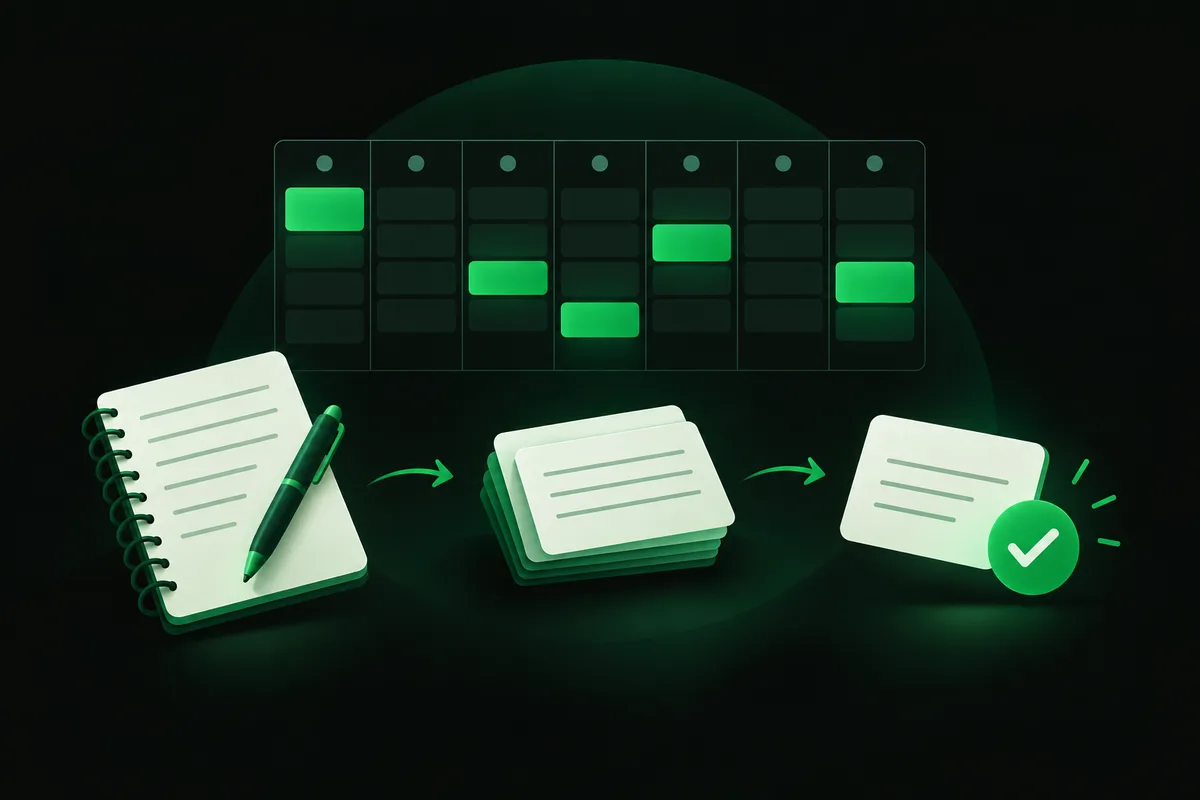
Practice testing your memory of the lecture material is one of the most effective ways to learn it, and flashcards are one easy way to do it. Spacing your review out over time is another powerful technique. Try reviewing your notes on the following schedule (feel free to modify it to fit your class schedule):
| Day | Activity | Method used |
|---|---|---|
| Class day | Take notes in your own words | Cornell, outline, mapping, charting or sentence |
| Same evening | Fill gaps, write cues and a summary | Cornell |
| A few days later | Cover the notes and answer each cue from memory | Practice testing |
| End of the week | Condense the week onto one page | Boxing or charting |
| Before the exam | Turn condensed notes into flashcards or a practice quiz, spread over several sessions | Practice testing and distributed practice |
Let StudySim make a practice quiz from your notes instead of writing the questions yourself, then cover up the answers and see how many you can explain without peeking.
Tools that help
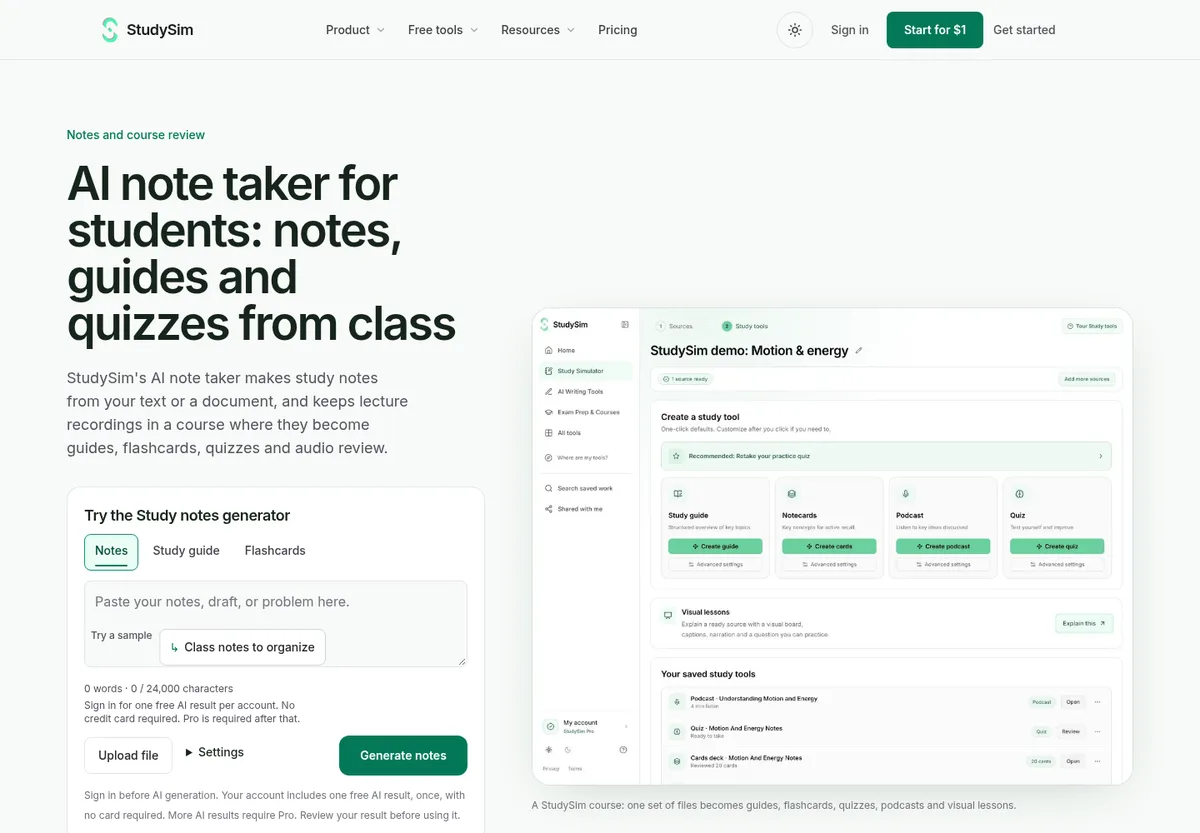
Research supports taking notes in your own words, whether you write on paper or type on a computer. Note-taking apps are most helpful for the after-class steps: condensing and organizing your notes, and creating practice tests.
We make StudySim. Lecture videos, PDFs, slides and more can be uploaded to a StudySim course, along with public YouTube links, and turned into study guides, flashcards, quizzes, audio review and more. StudySim’s AI note taker for students can also create study notes from documents or pasted text. It doesn’t record live lectures, so you still take your own notes in class. You can also turn a PDF into flashcards or run your condensed notes through the study guide generator. Signing in gets you one free AI result per account; after that, Pro is $1 for your first 3 days, then $20 a month or $120 a year.
Comparing apps? See our roundup of the best AI note takers for students or how StudySim compares as a NotebookLM alternative. There are more guides on the StudySim blog.
FAQ
What are the 5 note-taking methods?
The five classic methods, as listed by the University of Tennessee at Chattanooga, are the Cornell, outline, mapping, charting and sentence methods. Boxing and flow-based notes are two more that many students add for review and for understanding concepts.
What is the best note-taking method for studying?
For most lecture classes, the Cornell method is the strongest default because the cue column turns your notes into a self-test. Pair it with spaced review and practice questions before the exam.
Is it better to take notes by hand or on a laptop?
In studies by Mueller and Oppenheimer, students who took notes by hand did better on conceptual questions than laptop note-takers, largely because laptop notes were closer to word-for-word transcripts. If you type, summarize in your own words instead of transcribing.
How do you set up a Cornell notes page?
Draw a line about two inches from the bottom of the page, then a line about two inches from the left edge down to it. Take notes in the wide column, write questions and key terms in the narrow column, and summarize in the bottom box.
How do people with ADHD take notes?
Understood.org suggests simple structured formats for anyone who has trouble with executive function, including the split-page (Cornell) method, the outline method, bullet points with symbols, and mapping. Try one at a time and keep the one that sticks.
Can I combine note-taking methods?
Yes. Many students take notes in one format during class, such as Cornell or outline, and use another for review, such as boxing or a mind map. Consistency matters more than finding one perfect method.
About the author
Jozef Gherman is the founder of XYZAI, the company behind StudySim, where he builds AI tools that help students and writers study smarter and write with confidence. He writes about study techniques, exam prep, and practical ways to use AI for learning.