
How to Raise Your GPA: 9 Ways That Actually Work
To raise your GPA, start with the math: work out the average you need over your remaining credits, then find which courses and habits are pulling your grades down. The three changes that move the number most are focusing on your highest-credit courses, swapping rereading for self-testing, and getting help early instead of right before finals. Wondering how to raise GPA this semester? These 9 tips will help you improve your GPA in college or high school! Plus, a free GPA Recovery Planner to help you boost your GPA starting this semester! For details of the study methods behind some of these tips see how to study effectively.
| # | Way to raise your GPA | Why it works | When |
|---|---|---|---|
| 1 | Do the GPA math first | GPA is a credit-weighted average, so remaining credits limit what is possible | Before the term starts |
| 2 | Find what is dragging you down | Different causes of low grades need different fixes | Before the term starts |
| 3 | Put your effort into high-credit courses | A four-credit course affects your GPA more than a one-credit one | All term |
| 4 | Go to class and take part | In some courses, class participation is part of your final grade | Every class |
| 5 | Track every assignment and its weight | Keeping track of due dates and test dates helps you avoid missed work | Weekly |
| 6 | Test yourself instead of rereading | Practice testing was rated high utility; rereading was rated low utility | Every study session |
| 7 | Space your study out | Distributed practice was rated high utility; spacing beats cramming for long-term memory | Every week |
| 8 | Get help early | Using support early in a course is far more effective than catching up before finals | As soon as a course slips |
| 9 | Plan your courses and check retake policies | Some schools replace an old grade with a retake grade; others average the two | When you register |
Try the Study guide generator
How we chose these tips on how to raise GPA

We’ve seen a lot of articles answering the question, “How can I raise my GPA?” Everything from GPA calculator websites to college advising websites to study skill articles offer resources on this topic. Then we checked the study-method tips against learning research, mainly the large review of 10 learning techniques by Dunlosky and colleagues, published by the Association for Psychological Science. We read through as many of these resources as we could, keeping the repeated pieces of advice and tossing out the school-specific or one-size-doesn’t-fit-all advice (looking at you, sit in the front of the class tip).
We’ve listed the 9 tips below in the order we recommend you tackle GPA recovery (first figure out where you stand, next up working habits, and finally class selection). For each tip, we’ve included why it’s effective, how to do it, and examples.
1. Do the GPA math first
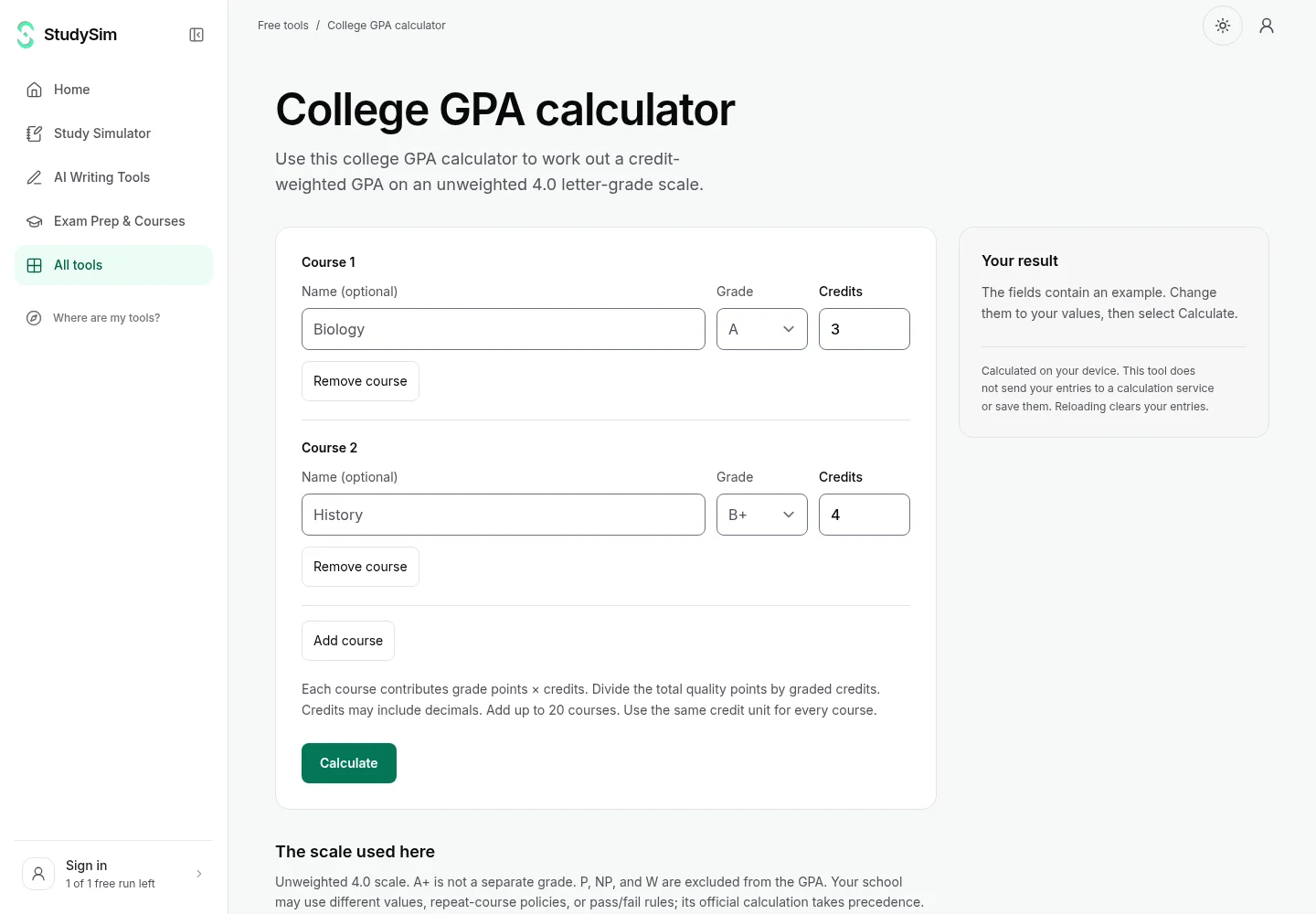
Figure out your current GPA and how many credits you have left. Your GPA is an average weighted by the number of credits for each class. This means the number of credits you have remaining in your degree program has a huge impact on how much you can raise your GPA. Figure out where you stand before you decide how to move forward. Calculate the GPA you need the rest of your degree to achieve your goal GPA.
- How: Multiply grade points by credits to get quality points for each course. Add up all your quality points. Add up all your graded credits. Then compute the average you need over your remaining credits to reach your target. The college GPA calculator, available for free, takes care of the credit-weighting for you and is run within your browser.
- Example: A student who wants to raise their GPA from 2.6 (calculated on 45 credits) to a 3.0 (calculated on 120 credits) needs 360 quality points in total (3.0 x 120). They already have 117 (2.6 x 45), so they need 243 more from their remaining 75 credits (120 - 45). That means averaging a 3.24, roughly a B-plus, for the rest of their degree.
The earlier you start working on improving your GPA, the more impact each semester will have. Using the standard GPA calculation formula ((current GPA × credits completed + new GPA × new credits) ÷ total credits) and assuming a 15 credit hour semester, here’s the impact a semester has on GPA starting with a 2.60 GPA:
| Credits already completed (at 2.60) | New GPA after a 15-credit semester at 3.50 | New GPA after a 15-credit semester at 4.00 |
|---|---|---|
| 15 | 3.05 | 3.30 |
| 30 | 2.90 | 3.07 |
| 60 | 2.78 | 2.88 |
| 90 | 2.73 | 2.80 |
It’s helpful to calculate your goal GPA to see if it’s an attainable goal before graduation. If it’s not, choose a new GPA goal that is. Going from a 2.60 to a 2.80 GPA is still progress you can point to on an application.
2. Find what is dragging your grades down
Study your transcript and pinpoint where you’re struggling. Rather than just trying harder in all classes, it’s more effective to figure out why you’re struggling so you can work to overcome that.
- How: Try to see if there is a pattern of poor grades. Are they all in one subject? During one particular semester? In a certain type of assessment (e.g. exams, group projects)? In subjects that have a lot of credits? A subject gap calls for tutoring, a time problem calls for schedule changes, and an exam problem calls for better study methods.
- Example: If you’re getting Cs on all of your exams but doing well on your homework, the problem is likely in how you’re studying for exams and not in needing to do more homework.
3. Put your effort into your highest-credit courses

Since GPA is calculated using a credit hour weighting system, a 4 credit class has much more of an impact on your GPA than a 1 credit class. Failing a 4 credit class will drastically decrease your GPA while receiving a C in a 1 credit class won’t impact your GPA as much.
- How: Make a list of all of the courses you are taking this term. Include the number of credits for each course and your current grade in each course. Focus your extra study time in your credit hour heavy classes when you’re close to moving up a letter grade.
- Example: If you move up from a C to a B in a 4 credit chemistry course, your number of quality points goes up by 4. If you do this in a 1 credit lab, your number of quality points only goes up by 1.
4. Go to class and take part
Attend class! Not only will you learn more by paying attention, asking questions and participating in class discussion, some classes use participation in final grades. Chances are, if your professor is harping on a certain topic in class, it will be on the exam!
- How: go to every class, review your notes the same day while they are fresh, and bring one question to each lecture or section. Go to office hours with questions! Going to office hours is an easy way to participate in class and learn more about how to excel in class (aka earn those points!).
- Example: Jot down 2 questions that you have after reading the assigned material before coming to class. Asking one of them counts as participation and gets you an answer you would otherwise have to look up.
5. Track every assignment and its weight
Turn in all assignments on time for full credit! You can use a paper planner, digital calendar, notebook, etc. to keep track of what’s due when and make sure you’re submitting everything on time for full credit. Know what each assignment is worth so you can prioritize accordingly!
- How: copy every due date from each syllabus into one calendar in the first week. Our weighted grade calculator will help calculate what your grade would be now based on the weight of each item and your scores, try it!
- Example: Suppose homework counts for 20% of your final grade, and you've missed two homework assignments. Plug in your scores and see the effect of those zeroes, and what you could gain by doing well on the final!
6. Test yourself instead of rereading

Practice testing! Instead of rereading and highlighting (low utility study skills according to the Dunlosky review), challenge yourself by working through practice problems and old quizzes. Students in a classic study Roediger and Karpicke, were able to recall significantly more information on delayed tests after being quizzed on material as opposed to restudying the material, despite reporting feeling more confident after restudying. This is covered in more detail in our active recall guide, which goes over ways of doing this effectively.
- How: Try to recall as much as you can after a lecture. Close your notes and write everything down that you can remember, then see what you’ve missed. Before an exam, work practice problems and old quizzes under time.
- Example: paste a week of lecture notes into StudySim's free AI quiz generator to get a five-question practice quiz with answers and explanations, or turn a PDF into flashcards for terms and definitions. Check your answers and study the problems you got incorrect.
7. Space your study out instead of cramming
Spread your studying out instead of cramming. This approach, known as distributed practice, was rated a high utility study skill in the Dunlosky review. Breaking up your studying helps information be retained longer which will be super helpful if your class has cumulative exams!
- How: Make a consistent schedule for studying and review subjects multiple times over the course of days and weeks. The spaced repetition guide comes with a free review schedule.
- Example: Spacing: Studying a topic for three hours per week for four weeks leads to better learning than studying it for 12 hours during the fourth week.
8. Get help early
Use campus resources! Tutoring centers, writing centers, academic success coaching, supplemental instruction classes, study skill workshops… Most colleges offer these services for free, and many students never use them. Seek out these resources during the semester instead of waiting until finals week to try and catch up.
- How: the first time you get a grade you are unhappy with, book office hours or a tutoring session that week. Speak with an advisor if you’re dealing with outside stressors. Whether it’s health related, family related, financially related, etc., speak with an advisor to discuss your options.
- Example: A student who does poorly on a problem set goes to the tutoring center the following week, instead of waiting until just before the midterm to find out the knowledge gap has grown even larger.
9. Plan your courses and check retake policies
Choose your classes wisely! Try to pick a balanced schedule each semester with a few challenging classes and a few easier classes. Don’t overload yourself and try to avoid picking classes simply because they’re easier. Repeat classes if your policy allows! If you received a poor grade in a class and it’s weighing down your GPA, consider repeating the class if your school’s policy will allow it. Some schools average grades, some allow a set number of repeats to count and some replace grades.
- How: read your school's repeat policy and ask an advisor before you register. In high school, remember that a weighted GPA gives extra points for honors, AP and IB classes. Just make sure you can handle the extra work to receive good grades!
- Example: in the 2.6 GPA example above, retaking one failed three-credit course under a replacement policy and earning a B lowers the average needed over the rest of the degree to about 3.1.
How to raise GPA fastest: which ways to start with

These tips don’t have to be done all at once or in order.
| If you want to... | Start with tip # | Then |
|---|---|---|
| Know whether your target GPA is realistic | 1. Do the GPA math | 9. Plan your courses |
| Fix one or two bad grades | 9. Check retake policies | 3. Focus on high-credit courses |
| Do better on exams | 6. Test yourself | 7. Space your study out |
| Stop losing points on missed work | 5. Track assignments and weights | 4. Go to class |
| Rescue a course that is slipping now | 8. Get help early | 6. Test yourself |
Start where you feel you need the most improvement and implement additional tips as needed. Revisit your goal GPA each semester after receiving grades to make sure you’re still on track. With finals coming up, our 2-week plan for finals puts tips 6 and 7 on a calendar, and our guide on how to make a study guide helps you organize a whole course before you start testing yourself.
Free printable GPA recovery planner
We condensed all of these GPA raising tips into a printable 2 pager! It has a GPA math worksheet with the formula, a transcript pattern check, a course plan that lists credits and current grades, a weekly habit tracker for tips 4 to 8, and a term review box for after grades post. Download the GPA recovery planner (PDF) and fill in page one before the term starts.
As you’re studying, use StudySim to create flashcards and quizzes out of your class notes! Log which questions you answer incorrectly in the planner so you can revisit the material throughout the week.
FAQ
How to raise GPA in one semester?
How much one semester helps depends on how many credits you already have. With few credits behind you, a strong semester moves the average a lot; with many, change is slower. Do the math first, focus on high-credit courses, and test yourself instead of rereading.
Can I raise my GPA from 2.0 to 3.0 in one year?
It depends on your credits. For example, with 30 credits at a 2.0 and 30 more credits in the year, you would need straight 4.0 grades to reach 3.0. With more credits completed, a 3.0 takes longer, so use a GPA calculator to set a realistic target.
Does retaking a class raise your GPA?
At some schools the new grade replaces the old one in your GPA, which can raise it. At others both attempts count or the grades are averaged. Check your school's repeat policy and talk to an advisor before you retake.
Should I take easier classes to raise my GPA?
A balanced schedule helps, but avoid choosing classes only because they are easy, since a transcript with no rigor can limit your options. Mix demanding courses with ones you can do well in.
Does a summer class help your GPA?
It can, because extra credits at a strong grade add quality points. Check first whether the grade counts in your GPA, since some transfer or summer courses come in as credit only.
About the author
Jozef Gherman is the founder of XYZAI, the company behind StudySim, where he builds AI tools that help students and writers study smarter and write with confidence. He writes about study techniques, exam prep, and practical ways to use AI for learning.