
AI in Education Statistics 2026: 48 Data Points on How Students Use AI
AI in education statistics for 2026 show that most students now use AI: 84% of U.S. high schoolers used generative AI for schoolwork by May 2025, 92% of UK undergraduates use AI tools, and 64% of U.S. teens use chatbots. Policy and training lag behind, while early studies show real learning gains when AI is used as a tutor.
Updated November 1, 2026
| Group | AI use | Source |
|---|---|---|
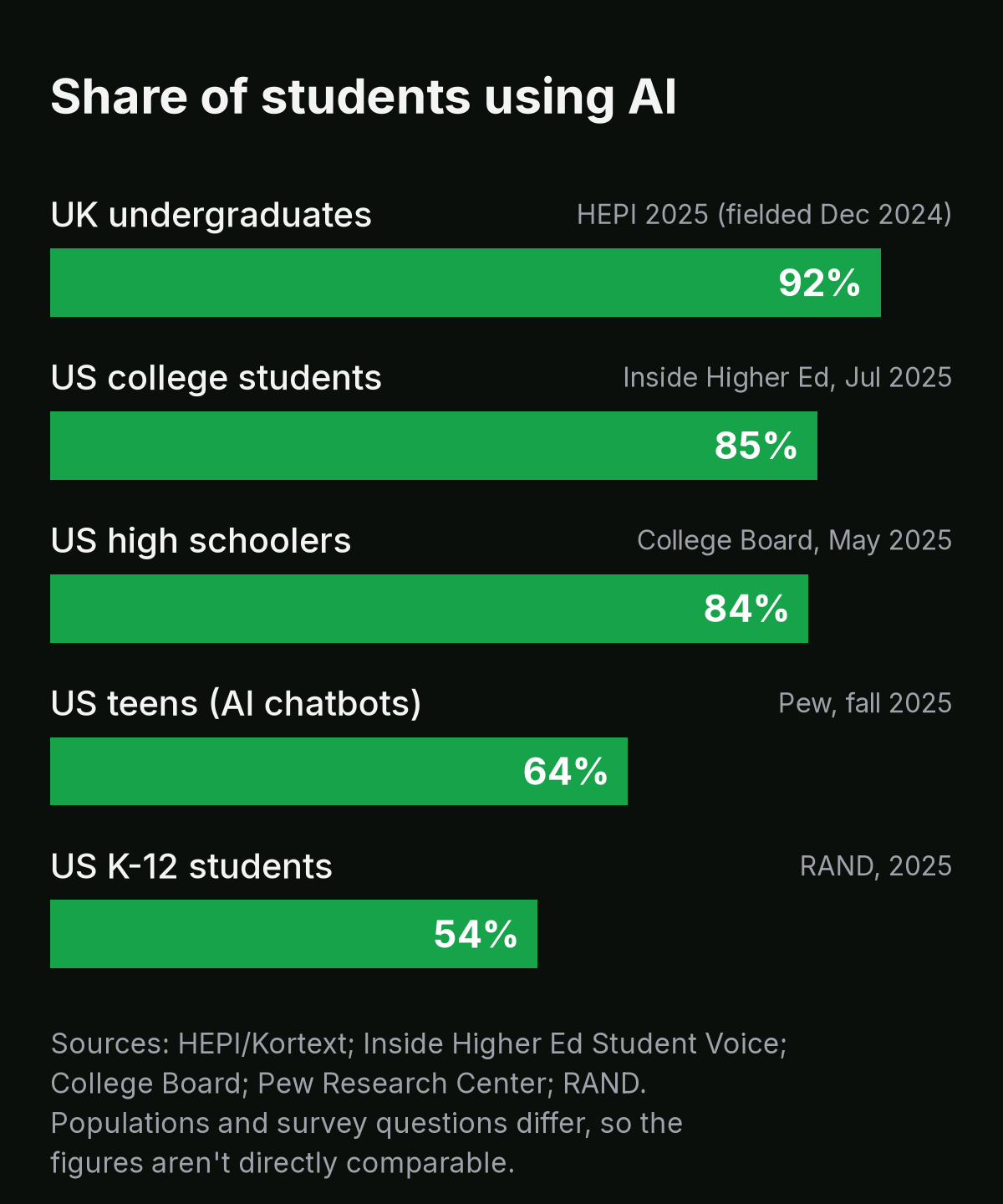
| U.S. high school students | 84% use generative AI for schoolwork (May 2025) | College Board |
| U.S. K-12 students | 54% use AI for school (2025) | RAND Corporation |
| U.S. teens 13-17 | 64% use AI chatbots (fall 2025) | Pew Research Center |
| U.S. college students | 85% used generative AI for coursework (July 2025) | Inside Higher Ed |
| UK undergraduates | 92% use AI tools (fielded Dec 2024) | HEPI 2025 survey |
| U.S. K-12 teachers | 60% used an AI tool for work (2024-25) | Gallup |
Try the Visual tutor
Key takeaways
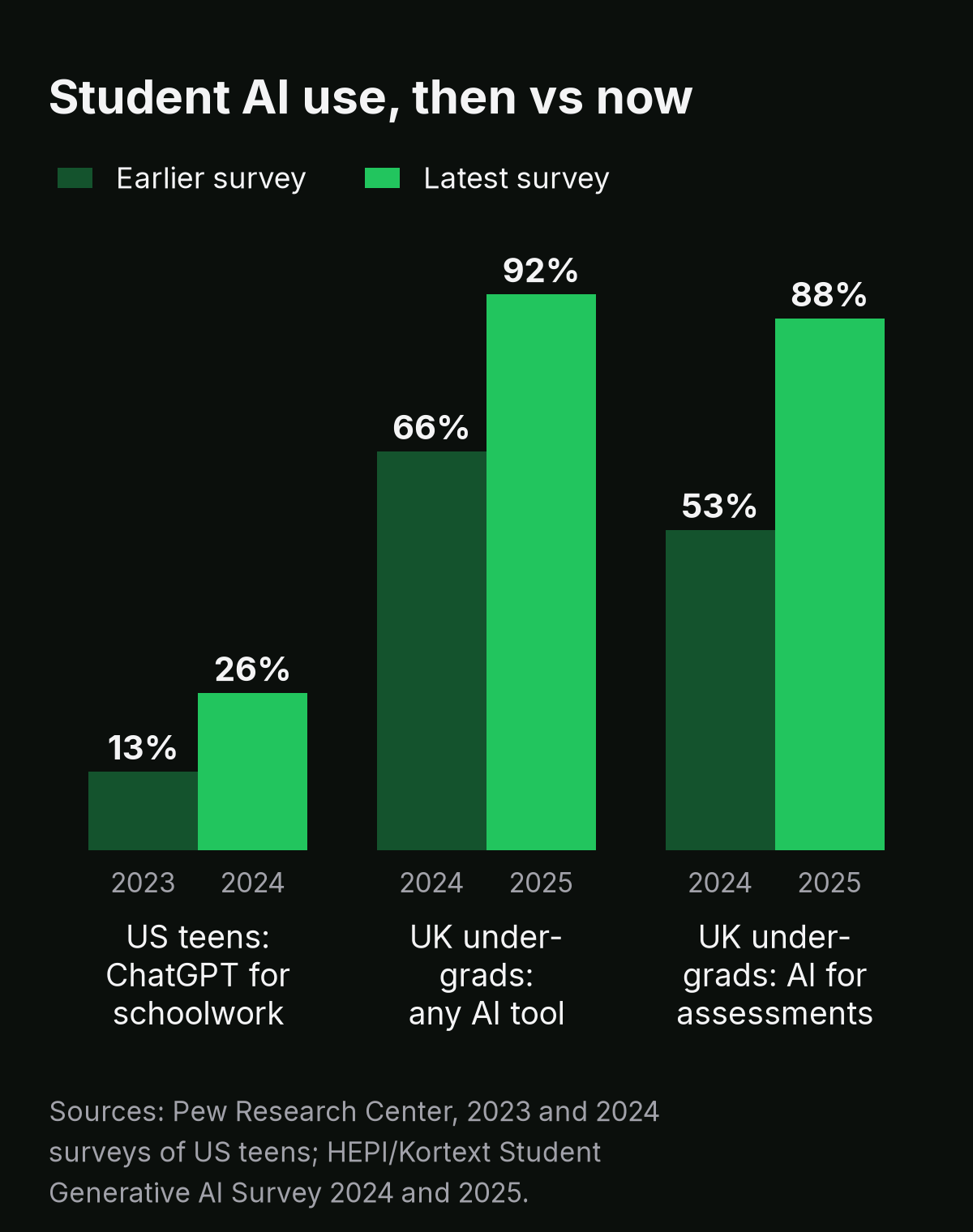
- In several surveys student AI use increased in about a year: Pew’s teen ChatGPT-for-schoolwork figure went from 13% to 26%, and the HEPI survey’s UK undergraduate figure from 66% (2024 survey) to 92% (2025 survey, fielded Dec 2024).
- Beyond essay writing, students use AI to brainstorm ideas, get explanations, and prepare for exams.
- Training lags use: over 80% of U.S. students report that their teachers have never explicitly instructed them in using AI tools for schoolwork.
- Worries are widespread: for UK students the top concerns are being accused of cheating and AI hallucinations.
- AI tools can significantly enhance learning when used thoughtfully. Research shows substantial learning gains when AI is integrated in line with good pedagogical practice.
This page collects 48 AI in education stats from surveys and peer-reviewed studies we opened and checked ourselves. If you want to see what studying with AI looks like in practice, StudySim has a free AI tutor that explains concepts from your own notes.
Students using AI statistics: how many use it
- About a quarter of U.S. teens ages 13 to 17 (26%) report using ChatGPT for schoolwork, twice the share of teens who said so in 2023 (13%) (fall 2024 survey, Pew Research Center).
- Teens in 11th and 12th grade (31%) are more likely than 7th and 8th graders (20%) to use ChatGPT for schoolwork (Pew Research Center, 2024 data).
- 79% of U.S. teens have heard of ChatGPT, up from 67% in 2023 (Pew Research Center, 2024 data).
- 64% of U.S. teens say they use an AI chatbot, and about three in ten use one every day (Pew Research Center, fall 2025).
- 16% of U.S. teens use AI chatbots several times a day or almost constantly (Pew Research Center).
- Teens ages 15 to 17 are more likely to say they use chatbots (68%) than are teens ages 13 to 14 (57%) (Pew Research Center).
- 84% of U.S. high school students reported using generative AI for schoolwork in May 2025, up from 79% in January 2025 (College Board).
- 54% of U.S. K-12 students said they used AI for school in 2025, a rise of more than 15 percentage points in one to two years (RAND Corporation).
AI in higher education statistics
- 92% of full-time UK undergraduates use some AI tool, up from 66% in the 2024 survey (HEPI 2025 survey, fielded Dec 2024).
- According to the survey, 88% of UK undergraduates reported using generative AI in at least one assessed task, compared to 53% of UK undergraduates the year before (HEPI 2025 survey).
- 85% of U.S. college students report using generative AI tools on academic work in the past year (Inside Higher Ed Student Voice (Generation Lab), July 2025).
- Generative AI use is higher among students than faculty, with 42% of U.S. college students reporting weekly generative AI use compared with 30% of instructors (Tyton Partners, Time for Class 2025).
- 67% of UK undergraduates think using AI is essential in today’s world, yet only 36% say their institution has trained them in AI skills (HEPI 2025 survey).
- The percentage of students who felt their staff were well-equipped to use AI rose from 18% (2024) to 42% (2025) (HEPI 2025 survey).
- 59% of UK undergraduates say the way they are assessed has changed a lot in response to generative AI (HEPI 2025 survey).
Which AI tools students use and what for
- ChatGPT is the most popular generative AI tool among US high school students, with 69% of them using ChatGPT to help with their homework/assignments in May 2025 (College Board).
- Half of U.S. high school students say they’ve used AI to help them with schoolwork – from brainstorming ideas to editing/reviewing essays, to doing research and finding sources (College Board).
- The most common uses of generative AI among college students include brainstorming ideas (55%), asking questions to get explanations like they’re getting from a tutor (50%), and studying for a test or quiz (46%) (Inside Higher Ed Student Voice (Generation Lab)).
- Only 25% of college students say they've used AI to do their homework for them and 19% have asked AI to write an entire essay for them (Inside Higher Ed Student Voice (Generation Lab)).
- In the HEPI 2025 survey, the most common reasons UK students give for using AI are to save time (51%) and to improve the quality of their work (50%) (HEPI 2025 survey).
- UK students mainly use AI tools in assessments to explain concepts, summarize articles and for research ideas (HEPI 2025 survey).
Studying for exams is one of the top three uses. Self-testing works best for that, which is why we built a free AI quiz maker and a tool to turn a PDF into flashcards. Instead of rereading, try testing yourself on what you just read (active recall).
Student attitudes and concerns
- 54% of U.S. teens say it is acceptable to use ChatGPT to research new topics; only 9% say it is not (Pew Research Center, 2024 data).
- 29% of teens say using ChatGPT to solve math problems is acceptable, while 28% say it is not (Pew Research Center). On whether or not using ChatGPT for writing essays is acceptable, 42% said that it is not acceptable, whereas 18% said that it is acceptable (Pew Research Center). More than half of UK undergraduates (53%) cited a fear of being accused of cheating as a reason for not using AI tools, with a similar proportion (51%) concerned about receiving incorrect results or “hallucinations” (HEPI 2025 survey).
- Half of U.S. high schoolers don’t agree or disagree that AI’s benefits outweigh its risks, and a quarter agree and a quarter disagree (College Board).
- 61% of parents, 55% of high schoolers, 48% of middle schoolers and 22% of district leaders agree that more AI use will harm students' critical thinking (RAND Corporation). 55% of college students who used AI for coursework in the past year say it has had mixed effects on their learning and critical thinking, and 27% say the effects were positive (Inside Higher Ed Student Voice (Generation Lab)).
- Pressure to get good grades (37%) is the most common reason that students give for their peers’ AI misuse (Inside Higher Ed Student Voice (Generation Lab)).
AI in education statistics on teachers and school policy
- 53% of U.S. teachers in English, math and science reported using AI for work related to their school in 2025 (RAND Corporation).
- 60% of U.S. public K-12 teachers said they used an AI tool for their work in the 2024-25 school year (Gallup and the Walton Family Foundation).
- 32% of teachers use AI tools at least weekly (Gallup and the Walton Family Foundation).
- AI can help teachers save time. For those who use AI at least weekly, the average amount of time reported saved was 5.9 hours per week (Gallup and the Walton Family Foundation).
- More than 80% of U.S. students report that their teachers have not explicitly instructed them on how to use AI tools for schoolwork (RAND Corporation).
- As of spring 2025, 35% of U.S. district leaders reported their districts offered some form of AI training to students (RAND Corporation).
- 45% of principals report their school or district has policies or guidance around AI, and 34% of teachers report there are policies in place about AI and academic integrity (RAND Corporation).
- 55% of U.S. high school principals say their school has not blocked generative AI on its network (College Board).
- 40% of UK undergraduates disagree with the statement that their university encourages them to use AI (with 29% agreeing) (HEPI 2025 survey).
- 80% of UK undergraduates say their institution’s AI policy is clear (HEPI 2025 survey).
- Only 21% of U.S. college students pick AI-detection software as a way for colleges to respond to academic integrity threats (Inside Higher Ed Student Voice (Generation Lab)).
Learning outcomes: what studies show
- A 2025 meta-analysis of 51 studies found ChatGPT had a large positive effect on learning performance (g = 0.867) (Wang and Fan, 2025).
- Perceptions of learning (g = 0.456) and higher-order thinking (g = 0.457) were also positively affected, moderately (Wang and Fan, 2025).
- Effects on learning perception were larger for interventions lasting more than 8 weeks (g = 1.054) than for those under 1 week (g = 0.203) (Wang and Fan, 2025).
- Students using pedagogy-based AI tutor more than doubled their median learning gains compared to an in-class active learning group in a Harvard randomized controlled trial (Kestin et al., 2025).
- Of the students using AI tutor, 70% spent less than 60 minutes on the material, the length of the in-class lesson (Kestin et al., 2025).
Studies show AI can be effective when it prompts students to think rather than simply giving them answers. For tool picks, see our roundups of the best study apps and AI study tools.
AI in education statistics on market size
- The global AI in education market was valued at USD 8.3 billion in 2025 and is estimated at USD 11.4 billion in 2026 (Grand View Research).
- The market is projected to reach USD 57.2 billion by 2033, a 25.9% annual growth rate from 2026 (Grand View Research).
- In 2025, North America generated 37.5% of AI in education market revenue (Grand View Research).
StudySim usage data
These are StudySim's own first-party numbers from product analytics, pulled October 31, 2026, with internal and test accounts excluded. They come from one small and growing app, so treat them as a snapshot of how our users study, not as industry statistics.
- 604 study spaces were created by 399 users between July 31 and October 31, 2026.
- 781 sources, such as notes and PDFs, were processed for 304 users between July 31 and October 30, 2026.
- 573 study tools were generated in study spaces between July 31 and October 29, 2026: quizzes were 36%, study guides 30%, flashcard sets 19% and podcasts 15% (podcasts available from August 6).
- Of 315 tool runs between October 25 and October 31, 2026, the AI tutor accounted for 31%, quizzes 22%, study guides 12%, the problem solver 11%, flashcards 8%, podcasts 7% and other tools 10%.
- Sessions with study activity lasted a median of about 8 minutes (703 sessions, July 31 to October 31, 2026).
Methodology
Some statistics on this page come from a primary source (not a secondary site summarizing stats from elsewhere). Sources include survey publishers, research organizations, peer-reviewed academic journals, and a market research firm. We saved the exact quote and page where we found each statistic. We included statistics from 2025 and 2026, but some data points are from earlier survey years, which we’ve noted.
| Source | Published | Who was surveyed |
|---|---|---|
| Pew Research Center | 2025-01-15 | 1,391 U.S. teens ages 13-17, surveyed Sept. 18-Oct. 10, 2024 (Ipsos KnowledgePanel) |
| Pew Research Center | 2025-12-09 | 1,458 U.S. teens ages 13-17, surveyed Sept. 25-Oct. 9, 2025 (Ipsos) |
| College Board | 2025-10-06 | U.S. high school students, parents and educators; surveys June 2024-June 2025 (sample size not stated on page) |
| RAND Corporation | 2025-09-30 | Nationally representative samples of U.S. K-12 students, parents, teachers, principals and district leaders, 2025 (sizes in full report) |
| HEPI and Kortext, Student Generative AI Survey 2025 (fielded Dec 2024) | 2025-02-26 | 1,041 full-time UK undergraduates, Savanta, December 2024 |
| Inside Higher Ed Student Voice (Generation Lab) | 2025-08-29 | 1,047 U.S. students at 166 two- and four-year institutions, July 2025 |
| Tyton Partners, Time for Class 2025 | 2025-06-11 | 3,300+ students, instructors and administrators at 900+ U.S. colleges |
| Gallup and the Walton Family Foundation | 2025-06-24 | 2,232 U.S. public K-12 teachers, March 18-April 11, 2025 (RAND American Teacher Panel) |
| Wang and Fan, Humanities and Social Sciences Communications (meta-analysis) | 2025-05-06 | 51 (quasi-)experimental studies published Nov. 2022-Feb. 2025 |
| Kestin et al., Scientific Reports (randomized controlled trial) | 2025-06-03 | Harvard introductory physics students, Fall 2023 (194 eligible students) |
| Grand View Research | 2026 (report covers 2026-2033) | Market sizing estimate (not a survey) |
How to cite this page
Gherman, J. (2026). AI in Education Statistics 2026: 48 Data Points on How Students Use AI.
Feel free to use any of the statistics on this page with a link back to this page. We also appreciate citations to the original source (linked next to each statistic).
FAQ
What percentage of students use AI?
It depends on the group. 84% of U.S. high school students used generative AI for schoolwork in May 2025 (College Board), 85% of U.S. college students used it for coursework in the past year (Inside Higher Ed), and 92% of UK undergraduates use AI tools (HEPI 2025 survey, fielded Dec 2024).
What are the key AI in higher education statistics?
88% of UK undergraduates have used generative AI for assessments (HEPI 2025 survey, fielded Dec 2024), and 42% of U.S. college students use it weekly (Tyton Partners). Only 36% of UK students have received AI training from their institution.
What do students use AI for most?
U.S. college students most often use it to brainstorm ideas (55%), ask it questions like a tutor (50%) and study for exams or quizzes (46%) (Inside Higher Ed).
Does AI improve learning?
A 2025 meta-analysis of 51 studies found a large positive effect of ChatGPT on learning performance (Wang and Fan), and a Harvard trial found an AI tutor more than doubled median learning gains versus active learning in class (Kestin et al.).
How many teachers use AI?
60% of U.S. public K-12 teachers used an AI tool for work in the 2024-25 school year, and weekly users save about 5.9 hours a week (Gallup).
About the author
Jozef Gherman is the founder of XYZAI, the company behind StudySim, where he builds AI tools that help students and writers study smarter and write with confidence. He writes about study techniques, exam prep, and practical ways to use AI for learning.